



Article
AI's Unexpected Role in Enhancing My Coding Skills

I Was Wrong
When I first started using ChatGPT for SQL queries, I was blown away by how it transformed hours-long tasks into mere minutes of processing. However, This staggering efficiency brought an unexpected quandary. Did I still need to improve my skills if AI could outperform me so dramatically? Initially, I saw little reason to compete against such precision. Yet, this was a fundamental misunderstanding on my part. As I integrated AI more deeply into my work, I discovered its value not just in handling tasks but in significantly enhancing my coding abilities by pushing the boundaries of what I thought possible.
Exploring the Depths of SQL with AI
ChatGPT became more than a tool; it became a mentor. As I tasked it with more complex queries, each solution it provided was not only a completed task but also a lesson in advanced SQL. This AI did not just do the work. It illuminated paths I had not even considered, turning complex data manipulation and optimisation techniques into understandable, approachable concepts.
Today, my ability to leverage advanced SQL functionalities is intricately tied to my deepened understanding of the code that AI generates. ChatGPT is instrumental in this process; it deconstructs each code line, explaining its rationale and strategy. This is not just about following steps; it is about grasping the underlying principles that make those steps effective.
Now, as I deal with more complex queries involving elaborate conditions and data filtering that require high computational effort, ChatGPT also proves invaluable from another point of view. It optimises code to ease server load and explains every step, helping me understand this area. This allows me to handle previously daunting complex tasks and equips me with the knowledge to instruct AI more effectively in the future.
Looking back on the path from doubt to reliance, I am amazed at how my perspective on AI has transformed. What began as a tool to expedite mundane tasks has blossomed into a crucial element of my professional development, pushing me to learn and adapt at an unprecedented pace.
Summary
Common questions on this article's topic
Can AI actually help you become a better programmer?
How does AI serve as a coding mentor?
Is it worth learning to code if AI can write code for you?
Can AI help with SQL query optimisation?
How has the perception of AI among developers changed?
What is the relationship between AI assistance and professional growth?
If you have any thoughts, questions, or feedback, feel free to drop me a message at mail@richardgolian.com.
 LinkedIn


Related articles
It cannot be done with 100% certainty. When I wrote about the dead internet theory, I wrote that we will no longer have certainty online and that for every verification tool there will be a tool that fools it. This is still true.
I see a lot of AI fatigue around me, loss of motivation and burnout. One example is a colleague who is leaving her job and says she plans to leave the digital marketing industry altogether.
Are you a content creator playing by the rules of YouTube, Instagram or Google? Are you a small business owner whose business model depends on how often Amazon recommends you, how expensive Facebook ad impressions will be or how expensive Google Ads clicks will be? If all or most of your contact with your audience or customers depends on a big platform showing you to them, you are not in a strong position.
More articles
The development of artificial intelligence changes how we look at which paths in life make sense. Which studies and which profession to choose.
It was Thursday, 31 March 2022, when I handed over the last of my responsibilities to my colleagues, closed my laptop and went to the library. I left my job for several months and immersed myself in philosophy. And I am immensely grateful for it. Today I am, like most people, on a merry-go-round, and it is hard for me to stop and think about the fundamental questions of my own life.
It was September 2023. My life, my work, everything was completely different from now. It was simpler. I owned almost nothing. I needed to film an advert, I went up to a floor inside the company where the product I needed for that advert was, and there I noticed her for the first time. She laughs at me when I describe it like this, but at that moment the universe told me, that is her.
How and why I am gradually leaving social media and the big platforms. When I read that Meta is testing a new way to charge for organic posts that link outside its platform, it confirms how right I was to become steadily less dependent on the big platforms and on social media. It does not mean I have left them completely. It means that whether or not I stay in touch with my readers depends on them less and less, and today almost not at all.
One of my family members described a firm that has its data in several different tools, and its employees still join it by hand, in spreadsheets. That is the ordinary state of firms. When somebody tells such people not to do it by hand and to use AI, they will not understand. Most firms do not even have the basic connectors between the tools they use. These firms need help with AI transformation.
The same task, two models. Fable 5 against Opus 4.8. On paper Fable is the better model, with a larger context and stronger specs. And still it lost. Opus handled the task with a single round of checking for 721,000 tokens, while Fable needed nine rounds and burnt through 2.78 million tokens. The difference was not in the model, but in how I set the task. And I know it, because I measured it.
A few weeks ago I installed a small local AI model on my laptop that watches a live camera feed. I turned the webcam on in the dark, and in near total darkness it recognised me and the objects in the room. That such things exist, I have known for a long time. What opened my eyes was the accessibility. I installed it in one prompt, free, and it runs entirely on my machine, sending data nowhere.
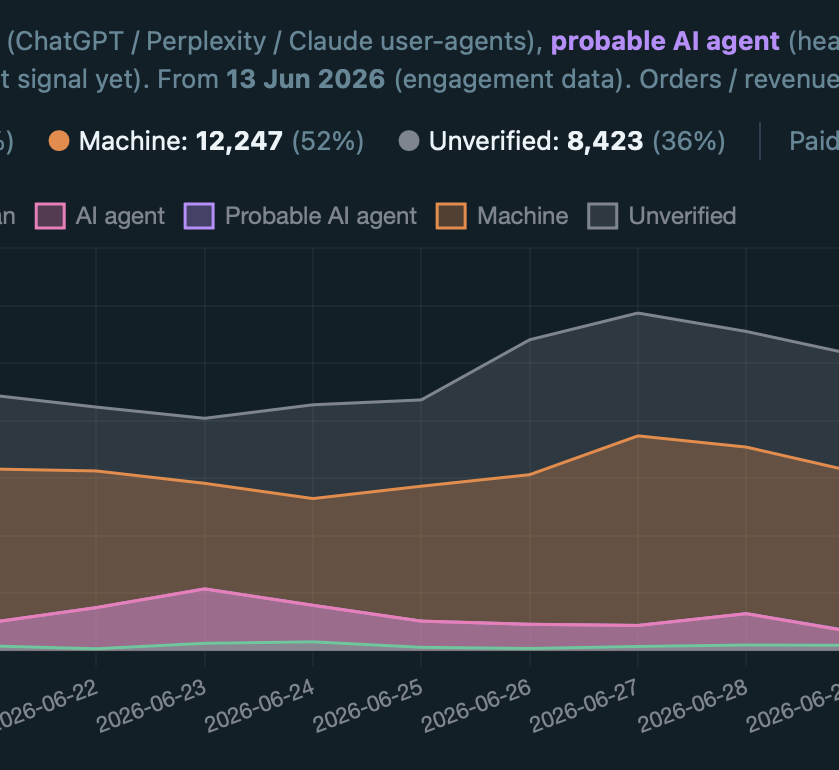
I once wrote about building my own privacy-friendly analytics tool. It had bot detection from the first version, yet it was not enough. Direct visits took a strangely high share of my traffic. When someone claims that 20% of their visits are bots and 80% are humans, I used to think the same. Today I would say the opposite ratio is closer to the truth. This is how I got there.
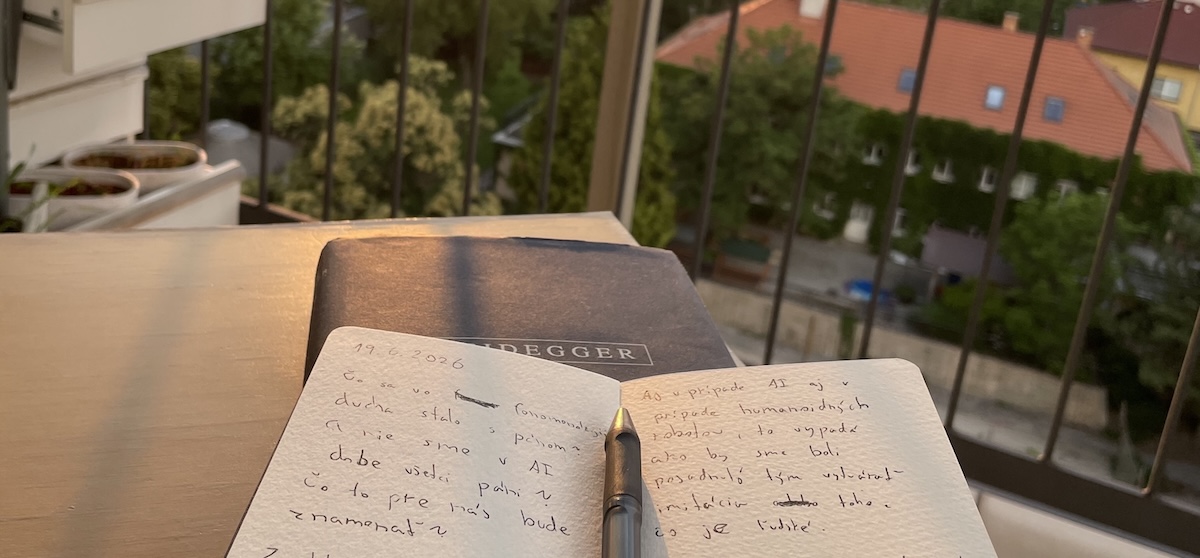
I have Heidegger and my notebook beside me. I am asking where all of this is heading, where artificial intelligence is taking us.

Four days in Catalonia. No computer, no AI, almost no social media. I bought this notebook so that I could write down what I would think about, and what I would come across and learn on the trip.