



Article
What AI Hides From You

Before you teach AI anything, look at what it is hiding
At university, I spent years studying the structure of understanding, how meaning is formed, how interpretation works, and what shapes it before we are even aware of it. I did not expect those concepts to become relevant to my work with AI. But they did.
This is part of a series I call Teaching AI to Understand. Before we get to teaching, though, we need to map the starting point. What does an AI model look like when you first get access to it? What is already built in? What can you change, and what can you not?
If you have worked with cloud models like Claude or GPT, you are working with something that already has layers of instructions, behavioural rules, and design choices baked in, before you type a single word. If you have tried running a local model, you know the trade-off: more control over what is visible, but significant limitations in capability.
This article is about the hidden layers.
The ancient principle I did not expect to find in AI
In my master's thesis at Charles University, I studied the structure of understanding, how meaning is formed, how interpretation works, and what shapes it before we are even aware of it. The material I examined was Roman rhetorical texts by Quintilian, Cicero, and the author of Rhetorica ad Herennium.
One of the things I found was a principle the Romans considered essential to the art of public speaking: the speech must not look prepared. The audience should not see the technique. The tools of persuasion should be invisible. In modern rhetorical scholarship, this principle is known as dissimulatio artis, the concealment of art.
Quintilian was specific about why. In the context of legal oratory, if the audience, the judges, could see the rhetorical technique being used, they would suspect that the speaker's art was being used against them. As he put it: the judge believes in rhetorical figures most when he thinks the speaker did not intend to use them. The concealment was not about elegance. It was about maintaining credibility and not threatening the fairness of judgment.
I did not think about this principle again for years. Then I started building AI agents.
What AI hides from you
When you interact with an AI model (whether it is Claude, ChatGPT, Gemini, or anything else), you are interacting with a system that is designed to produce outputs that look natural, confident, and human-like, while keeping its mechanics invisible. It does not do this out of intention. It has none. But it has been trained and configured this way.
There are at least eight layers of this concealment. Some are technical. Some are organisational. All of them affect what you get.
It Hides the Maths: How LLMs Generate Answers
An AI model does not retrieve facts. It generates sequences of tokens based on statistical probability. A token is a fragment of text, a word or part of a word, and the model works by predicting the next one, over and over. When it tells you something, it does not know how likely that something is to be true. The probability it operates on is over language patterns, not over facts. That gap, between predicting language and understanding it, is the real difference between AI and human intelligence.
I asked Claude directly whether it could tell me its confidence level on a factual answer. The response was straightforward: "I am not a system that calculates explicit probabilities over facts. The probability is over language, not over facts."
In practice, this means a correct answer and a hallucinated answer can look exactly the same to you. The model presents both with the same fluency and confidence.
Some APIs offer access to token-level probabilities (logprobs), but these are developer tools. The average user never sees them. And even logprobs reflect probability over word choices, not over factual accuracy.
It hides the system prompt
Before you send your first message, someone else has already instructed the model. Every major AI provider writes a system prompt, a set of rules that defines how the model should behave, what it should refuse, how it should present itself.
You cannot see this prompt. The model is typically trained not to reveal it. If you ask directly, responses vary. Some models will admit they have instructions but refuse to share details, others will deflect entirely.
This means that every response you receive is shaped by decisions someone else made. Decisions about tone, about what topics to engage with, about how to handle sensitive questions. You are not the first voice in the conversation. You are the second.
It hides how it used its tools
Modern AI models can search the web, execute code, query databases. Some of them tell you when they do, "I searched for this" or "I ran this code." But they do not tell you what they found and discarded. What sources they considered and rejected. What alternative results they saw and ignored.
You see the final output. You do not see the selection process.
It hides where it learned what it knows
When a model tells you a fact, you have no way of knowing whether that fact came from a peer-reviewed paper, a Wikipedia article, or a Reddit comment. The training data is not cited. It is not even accessible to the model itself.
Claude confirmed this directly: "I do not have access to where I learned something or with what certainty."
Tools like Perplexity cite sources, but those are sources from live search, not from the model's training data. The vast majority of what an AI model "knows" comes from training data you will never see referenced.
It Hides What It Does Not Know: AI Hallucinations
Instead of saying "I do not have enough information to answer this," a model can generate a fluent, confident, and completely fabricated response. This is what we call hallucination.
Modern models have improved at flagging their own uncertainty. Claude and GPT-4 say "I am not sure" more often than their predecessors. But the tendency is systemic. The model is trained to produce helpful, complete answers, and that training pull does not disappear.
When I was building autonomous agents, this became a real problem. An agent produced an SQL query that looked correct. Actions were taken based on its output. I only discovered the error when I dug deeper into the numbers. The agent had no mechanism to signal that something was off, and nothing in its output suggested I should doubt it.
It Hides Its Alignment Decisions (RLHF)
AI alignment is the process by which companies shape a model's behaviour after training. Through a technique called RLHF (reinforcement learning from human feedback), human evaluators rate the model's responses, and the model learns to produce the kind of output they preferred.
This process determines what the model will say, how it will say it, and what it will refuse to discuss. The people who define these rules are teams inside companies like Anthropic, OpenAI, and Google. You, as a user, have very limited influence over the values and priorities embedded in the model you are using.
When a model responds to a sensitive or contested question, its answer is shaped by these alignment decisions, but presented as a straightforward, helpful response.
It hides that you are not alone in the conversation
The system prompt is injected before your message. There is already another voice in the conversation before you arrive. The model has already received instructions about who it should be, how it should behave, and what it should prioritise.
You think you are talking to the model. You are talking to the model after someone else has already told it how to talk to you.
It hides its refusals behind care
When a model refuses to answer a question, it rarely says "my instructions prohibit me from discussing this." Instead, it says something like "I want to make sure I provide you with safe and accurate information."
The instruction is framed as concern. The boundary is presented as care.
This is sometimes genuinely about safety, and sometimes it is not. The line between the two is thin. That is precisely what makes it worth paying attention to.
Is AI manipulating us?
Everything I described above has a practical purpose. These design choices make AI models more useful, more pleasant to interact with, and easier to adopt.
But there is a cost.
Join the Library
Full access to my findings, personal stories, and what I learn from the people I meet.
Join the Library · €29.99 per year How I Fell in Love With Her, at First… How do you stop depending on social media? Can… How to Start With AI in a Company: Automating… Fable 5 vs Opus: I Ran the Same Audit… I Ran Object Detection on My Laptop, and Saw… Bot or Human? What My…Get the full article by email and feel free to reply if you want to discuss it further.
Summary
Common questions on this article's topic
What is dissimulatio artis and what does it have to do with AI?
What is a system prompt and why is it hidden?
What are AI hallucinations and why do they happen?
What is AI alignment and who controls it?
Is AI manipulating us?
What is the difference between cloud AI and local AI models?
How does AI actually work?
How does ChatGPT work?
What is a token in AI?
What is RLHF?
What is explainable AI?
Can AI lie?
How reliable is AI?
If you have any thoughts, questions, or feedback, feel free to drop me a message at mail@richardgolian.com.
 LinkedIn


Related articles
A few weeks ago I installed a small local AI model on my laptop that watches a live camera feed. I turned the webcam on in the dark, and in near total darkness it recognised me and the objects in the room. That such things exist, I have known for a long time. What opened my eyes was the accessibility. I installed it in one prompt, free, and it runs entirely on my machine, sending data nowhere.
In April, in the first part of this series, I wrote about an AI prediction system I had started building on my own machine. At the time the software was a few hours old and the prediction record was empty. The record since then has shown one thing: the system does not yet understand the market it is being asked to forecast. It can pull macro context, book value, earnings. But it cannot put those together into something that helps it understand the price.
I am building an AI system to predict the S&P 500. It runs on my own machine, uses free public data (yfinance, FRED, the Shiller dataset), and grades every forecast against reality. This series documents the build itself: the decisions, the methodology, the mistakes. What I will eventually share from the running system is a separate question, and an honest one.
More articles
It was September 2023. My life, my work, everything was completely different from now. It was simpler. I owned almost nothing. I needed to film an advert, I went up to a floor inside the company where the product I needed for that advert was, and there I noticed her for the first time. She laughs at me when I describe it like this, but at that moment the universe told me, that is her.
How and why I am gradually leaving social media and the big platforms. When I read that Meta is testing a new way to charge for organic posts that link outside its platform, it confirms how right I was to become steadily less dependent on the big platforms and on social media. It does not mean I have left them completely. It means that whether or not I stay in touch with my readers depends on them less and less, and today almost not at all.
One of my family members described a firm that has its data in several different tools, and its employees still join it by hand, in spreadsheets. That is the ordinary state of firms. When somebody tells such people not to do it by hand and to use AI, they will not understand. Most firms do not even have the basic connectors between the tools they use. These firms need help with AI transformation.
The same task, two models. Fable 5 against Opus 4.8. On paper Fable is the better model, with a larger context and stronger specs. And still it lost. Opus handled the task with a single round of checking for 721,000 tokens, while Fable needed nine rounds and burnt through 2.78 million tokens. The difference was not in the model, but in how I set the task. And I know it, because I measured it.
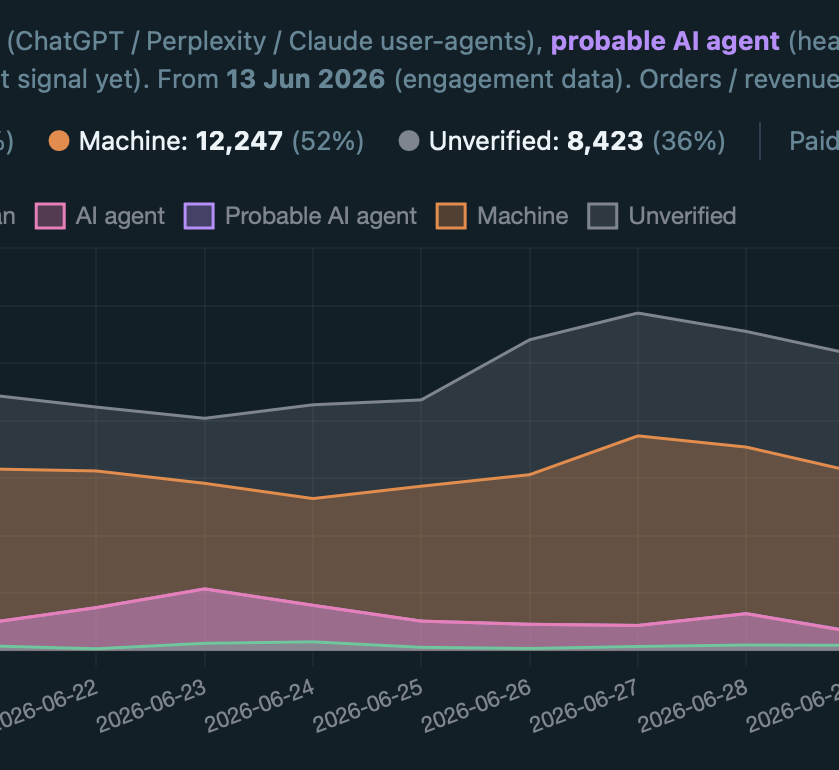
I once wrote about building my own privacy-friendly analytics tool. It had bot detection from the first version, yet it was not enough. Direct visits took a strangely high share of my traffic. When someone claims that 20% of their visits are bots and 80% are humans, I used to think the same. Today I would say the opposite ratio is closer to the truth. This is how I got there.
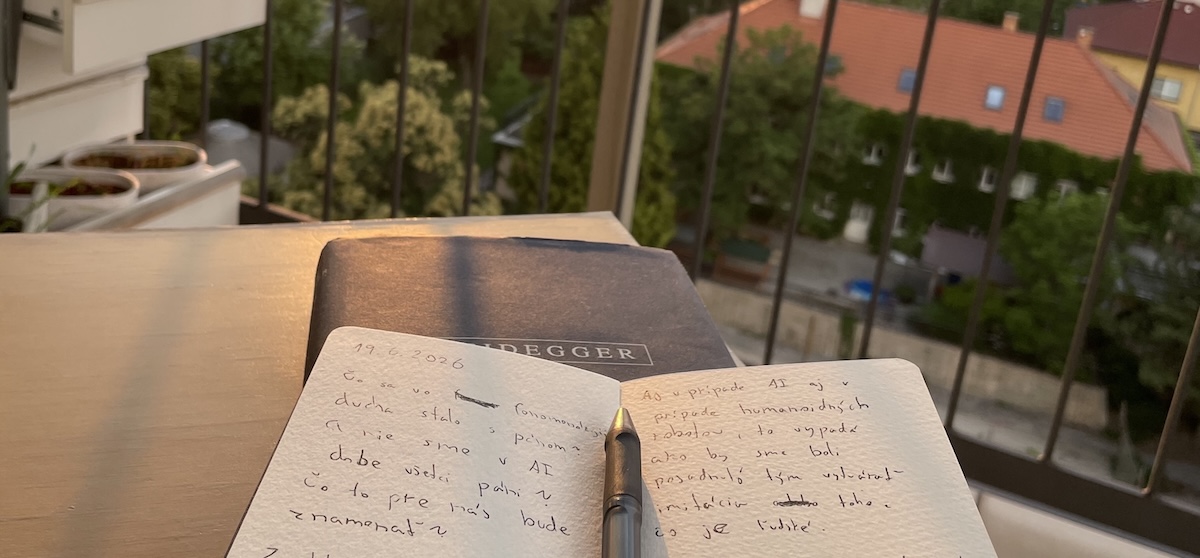
I have Heidegger and my notebook beside me. I am asking where all of this is heading, where artificial intelligence is taking us.
Seventy per cent. That is where the first AI output begins, even when you give it the full company context and the best examples from the past. We are talking about the kind of output that cannot be defined programmatically. It is more complex. Often it is creative work. On one repeated type of output I reached eighty per cent within a week. Every further percentage point is harder than the one before.
For a long time we treated the internet as the main road. The place where work and relationships happen. Yet most of what we see on it today is, or soon will be, AI-generated: text, images, profiles and comments. The internet is turning into an online game full of bots, where you cannot be sure that a human is on the other side of anything. So I ask: was the online world the main road, or only a temporary detour that part of us will return from, back offline?
A few days ago I interviewed a senior marketer. An experienced man, years of practice. I asked him about AI. He said he barely uses it. He had one bad experience with the output and decided he was too senior for it to add value when it is not perfect. I know the other side too: professionals who automate everything that can be automated.

Four days in Catalonia. No computer, no AI, almost no social media. I bought this notebook so that I could write down what I would think about, and what I would come across and learn on the trip.