


Article
Is AI Making Us Dumber?

I have conducted roughly one hundred and fifty practical interviews over the past four years. Fifty for data specialist roles. A hundred for advertising and performance marketing specialists.
Almost every one of them involved sitting down with a candidate over a practical task, something close to a real problem we actually need to solve at the company. Not theory. Not trivia. Applied problem-solving.
Over time, I started noticing a pattern.
It was not sudden. There was no single moment where the quality of candidates collapsed. But if you do this long enough, if you keep the same tasks and the same standards, you begin to see the curve.
And the curve is going down.
THE BEST RESULT I EVER SAW: WITHOUT AI
The strongest solution I have ever received came from a woman who had no AI.
No ChatGPT. No Copilot. No language model running in the background during her hour of preparation. She had the data, the task description, and her own mind.
She is a mathematics teacher. She works in education, promoting innovative Montessori-inspired approaches to teaching, the kind of person who spends her days figuring out how to make complex things understandable.
It showed.
I cannot share what she did specifically. The interviews are still ongoing and the tasks are still in use. But on a scale of one to ten, she scored a nine.
There were several moments during her presentation where I thought: this is a different league. Not one moment. Several.
She did not just answer the question. She noticed things in the data that were not part of the question. Things I had not explicitly asked about. Things that mattered.
That is the difference between AI-assisted output and genuine human problem-solving. AI answers what you ask. She answered what mattered.
It is the clearest example I know of how AI differs from human intelligence.
To this day, no candidate with AI access has come close.
THE DECLINE OF INDEPENDENT THINKING
Three years ago, roughly one in five candidates scored above six out of ten. Their solution was solid enough that the interview became genuinely interesting, a conversation, not an evaluation.
One in twenty scored eight or higher. That meant they solved the task independently, mostly correctly, with a level of critical thinking that made it clear they understood what they were doing.
Today, for data specialist roles, I would struggle to find anyone above five.
I am not talking about a subtle shift. I am talking about a measurable decline in independent problem-solving that has reshaped what I expect when I walk into an interview room.
For advertising specialists, the picture is slightly better. But the trend is the same.
THE AI PRODUCTIVITY PARADOX: MORE TOOLS, WORSE RESULTS
Data specialist candidates receive the dataset and the task one hour before the interview. They have time to prepare. They have access to any tools they choose, including AI models that are orders of magnitude more capable than anything that existed when I started doing these interviews.
More time. Better tools. Worse results.
In any other context, we would call this a crisis.
I am not the only one seeing this pattern. A randomised controlled trial by Grace Liu and colleagues (1,222 participants across multiple experiments) found that people who used AI assistance performed significantly worse once the tool was removed, even after only ten minutes of exposure. The researchers suggest that AI conditions people to expect immediate answers, denying them the experience of working through challenges on their own. The mechanism has a name: cognitive offloading.
An MIT Media Lab study of 54 participants using EEG measurements found that brain connectivity systematically decreased with the level of AI assistance, with the ChatGPT group showing the weakest neural coupling in areas associated with executive function, semantic processing, and attention regulation. The study is a preprint and has not yet been peer-reviewed, but the direction is consistent with what I observe in my interviews.
These are different domains, mathematics, essay writing. My domain is analytical problem-solving in data and marketing. But the underlying pattern is difficult to dismiss. Better tools. Less effort. Weaker independent performance.
Here is what it looks like in practice. The candidate takes the data, feeds it into a model, and brings the output to the interview. Sometimes the output looks clean. Sometimes even impressive, well-structured, visually polished.
Then I ask the first follow-up question.
"Why did you approach it this way?"
And the room goes quiet.
The answer was never theirs.
WHEN AI REPLACES THINKING: THE BLACKBOX GENERATION
The most striking interviews I have experienced recently involve young candidates who are skilled programmers. They know how to fine-tune models, adjust algorithms, work with complex tooling.
They present their solution confidently. The output looks structured, sometimes even impressive. But after a few follow-up questions, the picture becomes clear. They fed the data into a model, treated it as a blackbox, and accepted whatever came out. They do not say it that bluntly, but that is what happened.
Join the Library
Full access to my findings, personal stories, and what I learn from the people I meet.
Join the Library · €29.99 per year What should I study in the age of AI?… I Left My Job for Several Months to Read… How I Fell in Love With Her, at First… How do you stop depending on social media? Can… How to Start With AI in a Company: Automating… Fable 5 vs Opus: I Ran the Same Audit…Get the full article by email and feel free to reply if you want to discuss it further.
Summary
Common questions on this article's topic
Does AI make us dumber?
What is cognitive offloading?
How does AI affect job interview performance?
Can AI replace critical thinking?
What is the AI productivity paradox?
Is ChatGPT making us dumber?
If you have any thoughts, questions, or feedback, feel free to drop me a message at mail@richardgolian.com.
 LinkedIn


Related articles
A few weeks ago I installed a small local AI model on my laptop that watches a live camera feed. I turned the webcam on in the dark, and in near total darkness it recognised me and the objects in the room. That such things exist, I have known for a long time. What opened my eyes was the accessibility. I installed it in one prompt, free, and it runs entirely on my machine, sending data nowhere.
Yesterday I could not tear myself away from the computer. When I lifted my head, it was half past eight in the evening. I had been sitting alone upstairs for about three hours.
Will AI take my job? A certified Google trainer told me in June 2024 that my profession would cease to exist. Twenty-two months later, my job title has not changed, but ninety percent of what I do during the day is different. I have delegated more of my thinking to AI agents than I thought possible. I am not afraid. This is why, and what it means for anyone asking the same question.
More articles
The development of artificial intelligence changes how we look at which paths in life make sense. Which studies and which profession to choose.
It was Thursday, 31 March 2022, when I handed over the last of my responsibilities to my colleagues, closed my laptop and went to the library. I left my job for several months and immersed myself in philosophy. And I am immensely grateful for it. Today I am, like most people, on a merry-go-round, and it is hard for me to stop and think about the fundamental questions of my own life.
It was September 2023. My life, my work, everything was completely different from now. It was simpler. I owned almost nothing. I needed to film an advert, I went up to a floor inside the company where the product I needed for that advert was, and there I noticed her for the first time. She laughs at me when I describe it like this, but at that moment the universe told me, that is her.
How and why I am gradually leaving social media and the big platforms. When I read that Meta is testing a new way to charge for organic posts that link outside its platform, it confirms how right I was to become steadily less dependent on the big platforms and on social media. It does not mean I have left them completely. It means that whether or not I stay in touch with my readers depends on them less and less, and today almost not at all.
One of my family members described a firm that has its data in several different tools, and its employees still join it by hand, in spreadsheets. That is the ordinary state of firms. When somebody tells such people not to do it by hand and to use AI, they will not understand. Most firms do not even have the basic connectors between the tools they use. These firms need help with AI transformation.
The same task, two models. Fable 5 against Opus 4.8. On paper Fable is the better model, with a larger context and stronger specs. And still it lost. Opus handled the task with a single round of checking for 721,000 tokens, while Fable needed nine rounds and burnt through 2.78 million tokens. The difference was not in the model, but in how I set the task. And I know it, because I measured it.
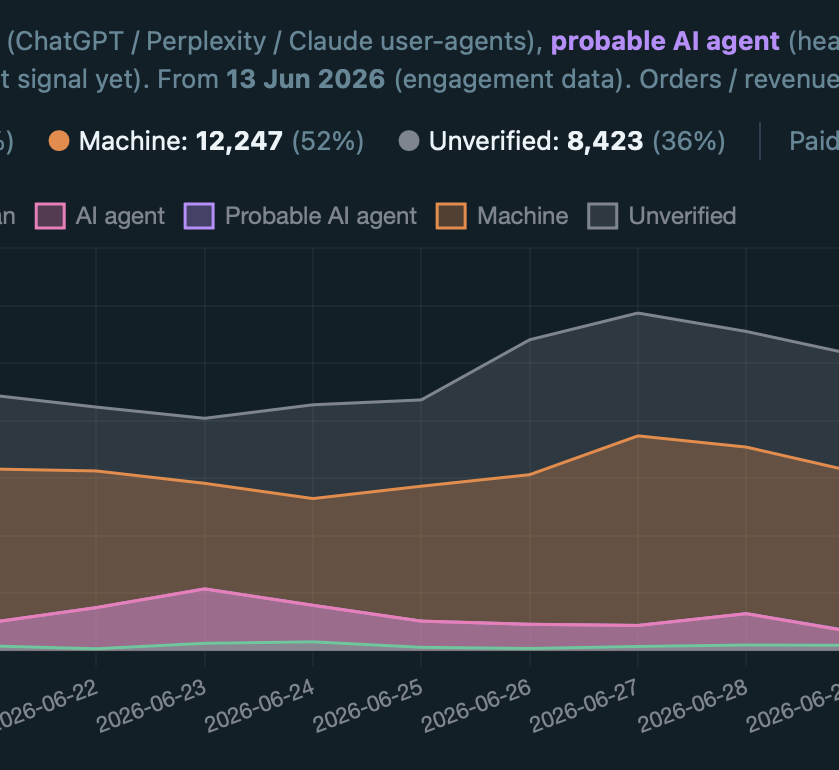
I once wrote about building my own privacy-friendly analytics tool. It had bot detection from the first version, yet it was not enough. Direct visits took a strangely high share of my traffic. When someone claims that 20% of their visits are bots and 80% are humans, I used to think the same. Today I would say the opposite ratio is closer to the truth. This is how I got there.
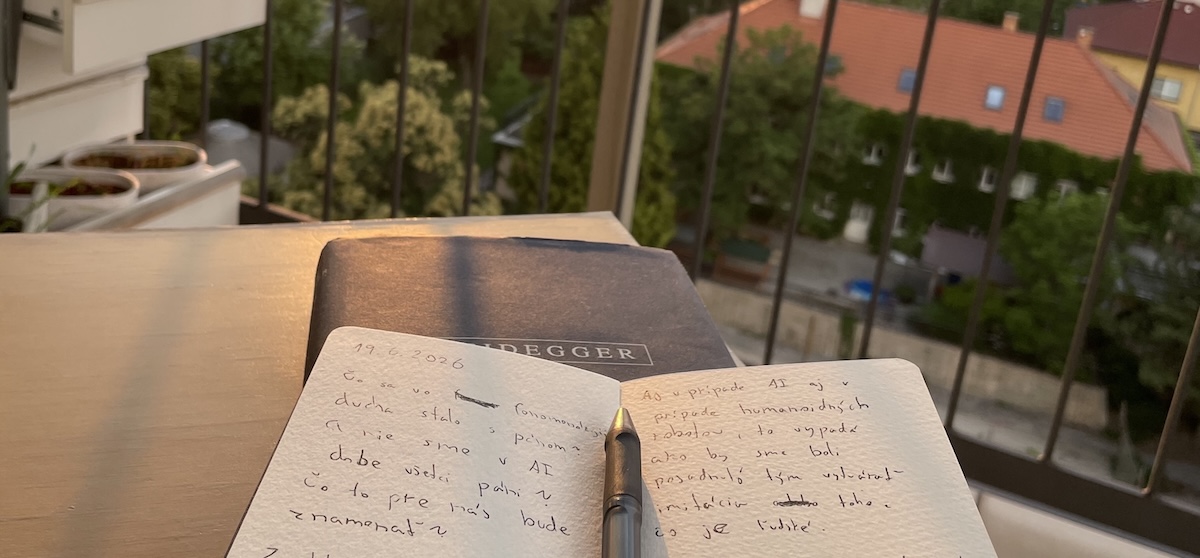
I have Heidegger and my notebook beside me. I am asking where all of this is heading, where artificial intelligence is taking us.
Seventy per cent. That is where the first AI output begins, even when you give it the full company context and the best examples from the past. We are talking about the kind of output that cannot be defined programmatically. It is more complex. Often it is creative work. On one repeated type of output I reached eighty per cent within a week. Every further percentage point is harder than the one before.
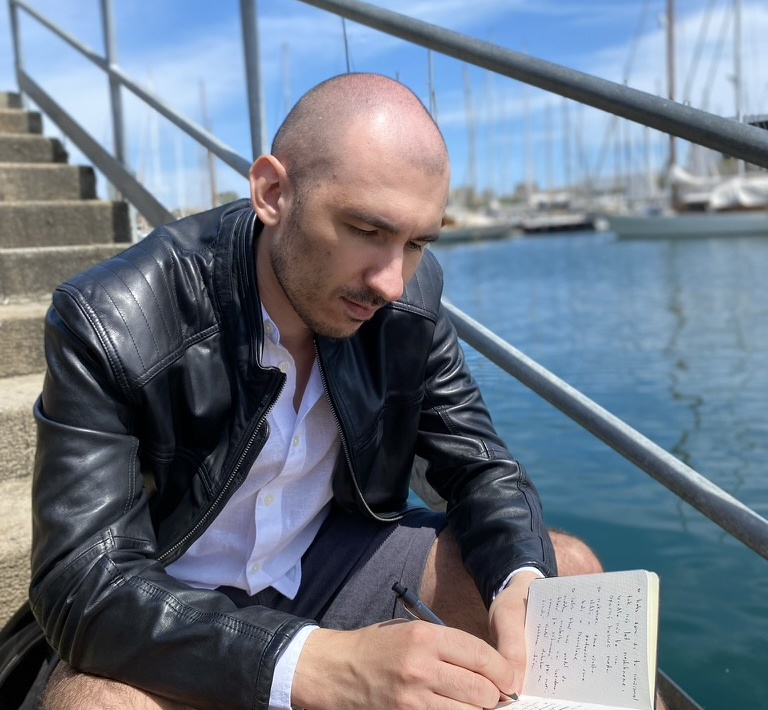
Four days in Catalonia. No computer, no AI, almost no social media. I bought this notebook so that I could write down what I would think about, and what I would come across and learn on the trip.