


Article
Why Was the European Union Created? Peace. And the USA, China, Russia and India?

The public debate on a united Europe is increasingly drifting into directions I no longer understand.
I am amazed at what we in Europe can seriously talk about, argue over, and let divide us. And I guarantee you, when someone in the future looks back at what we are doing today, they will rightfully call us fools.
Please, let us restart the public debate about Europe. From the ground up.
We understand the world first and foremost in practical terms. What affects us, we first grasp as something good, suitable for something, or, on the other hand, for example, as an obstacle.
So let us remind ourselves: why did we start uniting in Europe? What is the purpose of Europe, and is it fulfilling that purpose?
Why Was the European Union Created? For Peace
The Father of Europe, Robert Schuman, in the opening of his declaration that set European unification in motion, wrote:
“World peace cannot be safeguarded without the making of creative efforts proportionate to the dangers which threaten it.”
The entire declaration makes it explicitly clear that the purpose of European unification is peace. That the purpose of Europe is peace. And this peace is to be achieved by creating a system that makes armed conflict between its parts senseless:
“The solidarity in production thus established will make it plain that any war between France and Germany becomes not merely unthinkable, but materially impossible.”
Has it worked? Is the European Union fit and good for what it was created to achieve?
The answer is that armed conflict between EU member states is nonsensical and has never happened.
In this sense, Europe fulfills its purpose.
That is why we celebrate Europe Day. That is why I have a blue flag with yellow stars at home. I am proud of what we have achieved.
Are the debates that today appear in political struggles and divide Europe more important than this?
If not, why do we let ourselves be divided by them? Are we really so weak that we let ourselves be torn apart by some regulation or directive over absolute nonsense? If something bothers us, let us argue, change it, win elections, and fix what truly needs fixing. But I cannot understand how anyone could even think of destroying the foundation on which Europe stands. That I will never understand.
The Schuman Declaration and the Goal of World Peace
When I return to the opening thoughts of the Father of Europe’s declaration, they went even further, toward world peace:
“World peace cannot be safeguarded without the making of creative efforts proportionate to the dangers which threaten it.”
And even though the official European anthem is purely instrumental, so that no single language is favoured, an unofficial Latin lyric written for it speaks clearly about world peace. The first stanza goes:
Est Europa nunc unita,
et unita maneat.
Una in diversitate,
pacem mundi augeat.
Which means:
Europe is united now,
and may it remain united.
United in diversity,
may it contribute to world peace.
Europe, at its very beginning and still today, was meant not just as a peace project within its own borders, but as a contribution to peace in the world. And in my view, that is something we should remind ourselves of more often, especially today, when we are still very far from that, and world peace seems to be getting further away.
What seems obvious to me is that we cannot achieve it without broader cooperation, at the very least with other world powers. That is the real problem. That is what we should be discussing. That is where we should focus our energy.
Continue reading for free
Enter your email to keep reading for free. This also subscribes you to my monthly newsletter. No spam, unsubscribe anytime.
Sources
Summary
Common questions on this article's topic
What is the purpose of European unification?
Has the European Union fulfilled its founding purpose?
What is the purpose of the United States according to its founding?
What is China's modern national purpose?
What does the Third Rome mean in the context of Russia?
Is world peace achievable given these different national purposes?
Who was Robert Schuman?
What is the Schuman Declaration?
What is American exceptionalism?
What is the century of humiliation?
What is the Chinese Dream?
What is the motto of the European Union?
What do the words life, liberty and the pursuit of happiness mean?
If you have any thoughts, questions, or feedback, feel free to drop me a message at mail@richardgolian.com.
 LinkedIn


More articles
Are you a content creator playing by the rules of YouTube, Instagram or Google? Are you a small business owner whose business model depends on how often Amazon recommends you, how expensive Facebook ad impressions will be or how expensive Google Ads clicks will be? If all or most of your contact with your audience or customers depends on a big platform showing you to them, you are not in a strong position.
The development of artificial intelligence changes how we look at which paths in life make sense. Which studies and which profession to choose.
It was Thursday, 31 March 2022, when I handed over the last of my responsibilities to my colleagues, closed my laptop and went to the library. I left my job for several months and immersed myself in philosophy. And I am immensely grateful for it. Today I am, like most people, on a merry-go-round, and it is hard for me to stop and think about the fundamental questions of my own life.
It was September 2023. My life, my work, everything was completely different from now. It was simpler. I owned almost nothing. I needed to film an advert, I went up to a floor inside the company where the product I needed for that advert was, and there I noticed her for the first time. She laughs at me when I describe it like this, but at that moment the universe told me, that is her.
How and why I am gradually leaving social media and the big platforms. When I read that Meta is testing a new way to charge for organic posts that link outside its platform, it confirms how right I was to become steadily less dependent on the big platforms and on social media. It does not mean I have left them completely. It means that whether or not I stay in touch with my readers depends on them less and less, and today almost not at all.
One of my family members described a firm that has its data in several different tools, and its employees still join it by hand, in spreadsheets. That is the ordinary state of firms. When somebody tells such people not to do it by hand and to use AI, they will not understand. Most firms do not even have the basic connectors between the tools they use. These firms need help with AI transformation.
The same task, two models. Fable 5 against Opus 4.8. On paper Fable is the better model, with a larger context and stronger specs. And still it lost. Opus handled the task with a single round of checking for 721,000 tokens, while Fable needed nine rounds and burnt through 2.78 million tokens. The difference was not in the model, but in how I set the task. And I know it, because I measured it.
A few weeks ago I installed a small local AI model on my laptop that watches a live camera feed. I turned the webcam on in the dark, and in near total darkness it recognised me and the objects in the room. That such things exist, I have known for a long time. What opened my eyes was the accessibility. I installed it in one prompt, free, and it runs entirely on my machine, sending data nowhere.
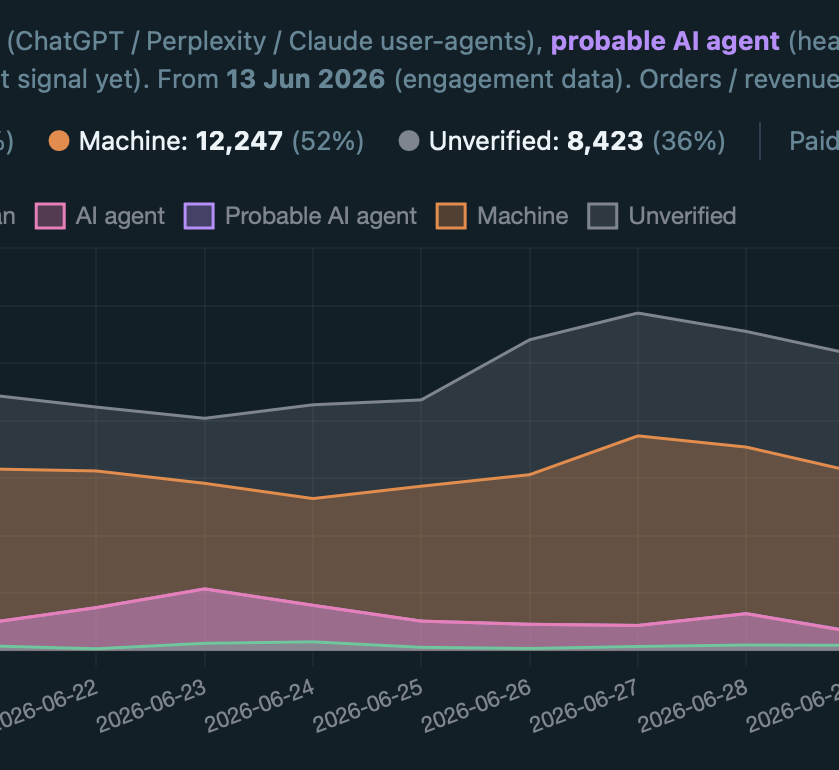
I once wrote about building my own privacy-friendly analytics tool. It had bot detection from the first version, yet it was not enough. Direct visits took a strangely high share of my traffic. When someone claims that 20% of their visits are bots and 80% are humans, I used to think the same. Today I would say the opposite ratio is closer to the truth. This is how I got there.
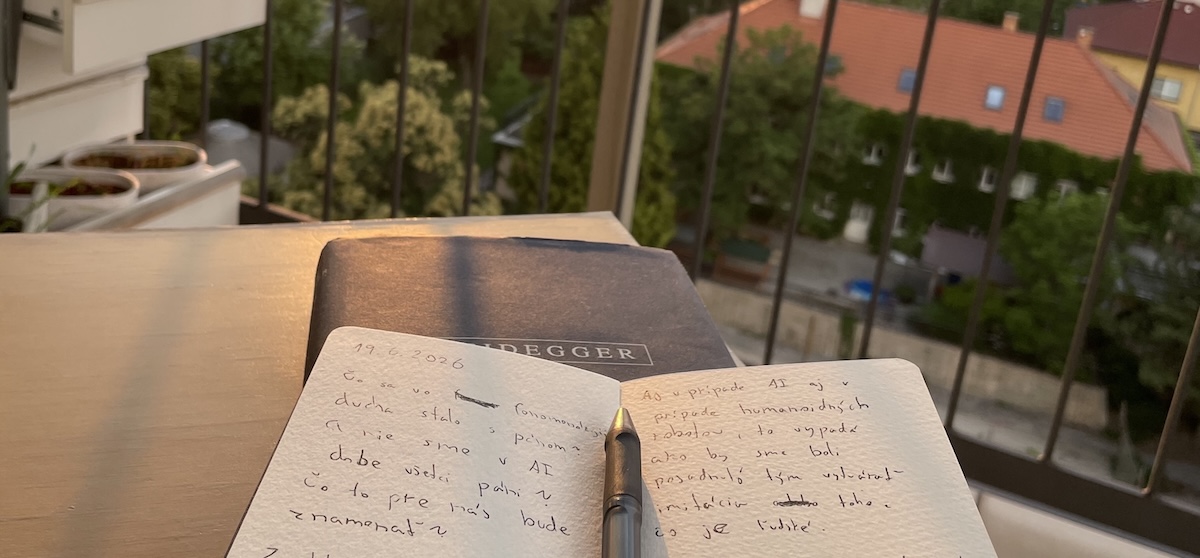
I have Heidegger and my notebook beside me. I am asking where all of this is heading, where artificial intelligence is taking us.
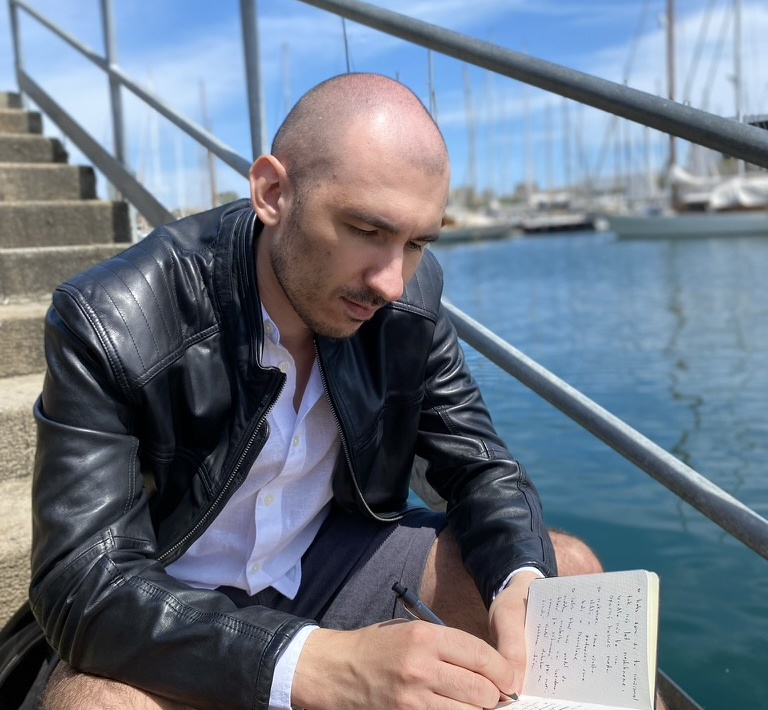
Four days in Catalonia. No computer, no AI, almost no social media. I bought this notebook so that I could write down what I would think about, and what I would come across and learn on the trip.