


Article
Political situation in Slovakia

What are the main political forces in Slovakia today? And how are they connected? Here is a quick overview.
Parliamentary parties after the 2023 election
The current Slovak parliament is shaped by two main groups, with several extra-parliamentary parties remaining active outside parliament.
1. Government coalition
- The government is made up of SMER-SD (Smer – sociálna demokracia), HLAS-SD (Hlas – sociálna demokracia), and SNS (Slovenská národná strana).
- SMER-SD (Smer – sociálna demokracia), led by Robert Fico, mixes conservative, nationalist values with socialist-style economic rhetoric and sharp criticism of the West.
- HLAS-SD (Hlas – sociálna demokracia), led by Peter Pellegrini (a former ally of Fico), presents itself as a more moderate, centrist alternative, though it now cooperates with SMER.
- SNS (Slovenská národná strana) is a traditional nationalist party, strongly focused on patriotism and conservative issues.
2. Democratic opposition
- The opposition is a mix of liberal, progressive, and centre-right forces:
- Progressive Slovakia (Progresívne Slovensko): A liberal, pro-European party, similar to En Marche! in France.
- Freedom and Solidarity (Sloboda a Solidarita – SaS): A liberal, economically right-leaning party.
- Christian Democratic Movement (Kresťanskodemokratické hnutie – KDH): A classic Christian-democratic party.
- Slovakia (Slovensko): Formerly known as OĽaNO, an anti-corruption movement led by Igor Matovič, now repositioned under a broader brand but still marked by populism and conservatism.
Extra-parliamentary forces
- Several former parliamentary parties failed to cross the threshold in the 2023 election:
- Republic (Republika): A far-right nationalist party, founded by former members of ĽSNS.
- Hungarian Alliance (Maďarská aliancia): A party representing the Hungarian minority, aiming for regional development and minority rights.
- Democrats (Demokrati): A centrist, pro-European party formed from former members of centre-right movements, advocating for reforms and moderation.
- We Are Family (Sme rodina): A populist party focused on social benefits and family support.
The bigger picture
Slovak politics today are even more fragmented than a few years ago. The traditional left-right division is almost irrelevant. New liberal forces are gaining ground. Nationalism and populism remain strong players, even outside parliament.
The country is deeply polarized between two visions: one that looks westward toward the EU and liberal democracy, and another that leans inward, focusing on national sovereignty and conservative values.
Continue reading for free
Enter your email to keep reading for free. This also subscribes you to my monthly newsletter. No spam, unsubscribe anytime.
Sources
Summary
If you have any thoughts, questions, or feedback, feel free to drop me a message at mail@richardgolian.com.
 LinkedIn


More articles
It was September 2023. My life, my work, everything was completely different from now. It was simpler. I owned almost nothing. I needed to film an advert, I went up to a floor inside the company where the product I needed for that advert was, and there I noticed her for the first time. She laughs at me when I describe it like this, but at that moment the universe told me, that is her.
How and why I am gradually leaving social media and the big platforms. When I read that Meta is testing a new way to charge for organic posts that link outside its platform, it confirms how right I was to become steadily less dependent on the big platforms and on social media. It does not mean I have left them completely. It means that whether or not I stay in touch with my readers depends on them less and less, and today almost not at all.
One of my family members described a firm that has its data in several different tools, and its employees still join it by hand, in spreadsheets. That is the ordinary state of firms. When somebody tells such people not to do it by hand and to use AI, they will not understand. Most firms do not even have the basic connectors between the tools they use. These firms need help with AI transformation.
The same task, two models. Fable 5 against Opus 4.8. On paper Fable is the better model, with a larger context and stronger specs. And still it lost. Opus handled the task with a single round of checking for 721,000 tokens, while Fable needed nine rounds and burnt through 2.78 million tokens. The difference was not in the model, but in how I set the task. And I know it, because I measured it.
A few weeks ago I installed a small local AI model on my laptop that watches a live camera feed. I turned the webcam on in the dark, and in near total darkness it recognised me and the objects in the room. That such things exist, I have known for a long time. What opened my eyes was the accessibility. I installed it in one prompt, free, and it runs entirely on my machine, sending data nowhere.
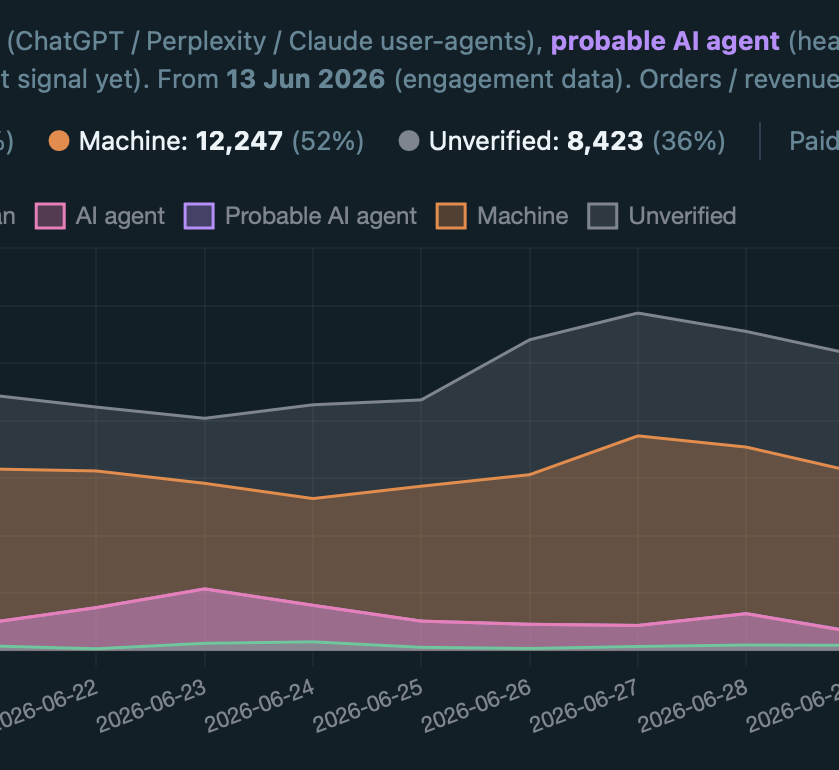
I once wrote about building my own privacy-friendly analytics tool. It had bot detection from the first version, yet it was not enough. Direct visits took a strangely high share of my traffic. When someone claims that 20% of their visits are bots and 80% are humans, I used to think the same. Today I would say the opposite ratio is closer to the truth. This is how I got there.
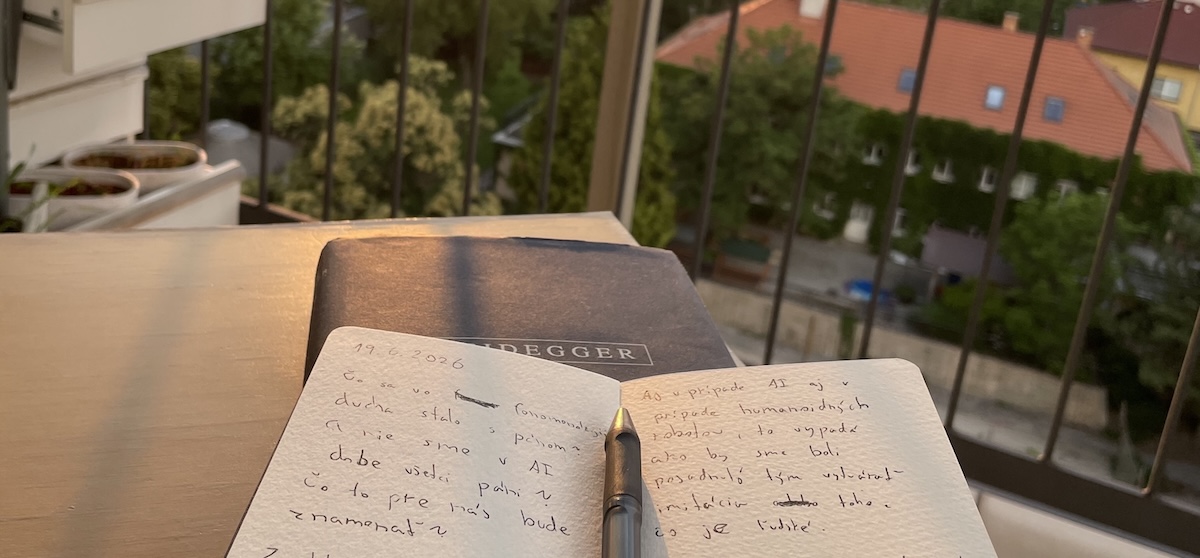
I have Heidegger and my notebook beside me. I am asking where all of this is heading, where artificial intelligence is taking us.
Seventy per cent. That is where the first AI output begins, even when you give it the full company context and the best examples from the past. We are talking about the kind of output that cannot be defined programmatically. It is more complex. Often it is creative work. On one repeated type of output I reached eighty per cent within a week. Every further percentage point is harder than the one before.
For a long time we treated the internet as the main road. The place where work and relationships happen. Yet most of what we see on it today is, or soon will be, AI-generated: text, images, profiles and comments. The internet is turning into an online game full of bots, where you cannot be sure that a human is on the other side of anything. So I ask: was the online world the main road, or only a temporary detour that part of us will return from, back offline?
A few days ago I interviewed a senior marketer. An experienced man, years of practice. I asked him about AI. He said he barely uses it. He had one bad experience with the output and decided he was too senior for it to add value when it is not perfect. I know the other side too: professionals who automate everything that can be automated.
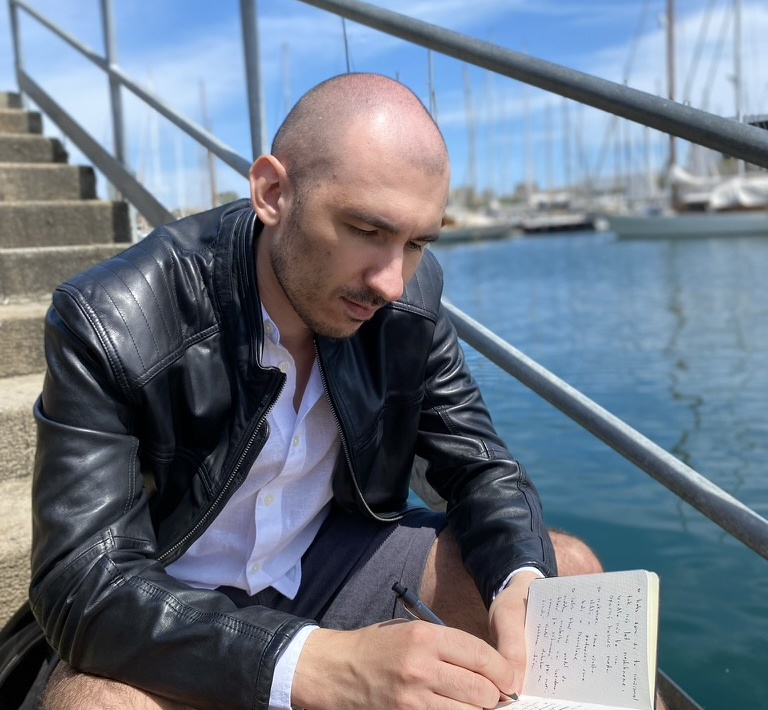
Four days in Catalonia. No computer, no AI, almost no social media. I bought this notebook so that I could write down what I would think about, and what I would come across and learn on the trip.