


Article
Dependent on AI: Are We Still Masters, or Slaves?

You will stop knowing things you once knew. If AI writes for you for years, in time you will no longer be able to write a proper text yourself. A muscle you do not train grows weak.
You will grow more and more dependent, and you will call it freedom. The more the machine makes your life easier, the less you can manage without it. It looks as though you control it, but in truth you cannot function without it. A master who becomes dependent on his servant.
Once almost everyone could light a fire. Today few can, and without matches they are helpless. Once people did sums in their heads. Since we have had calculators, many no longer can. And I cannot imagine why it would turn out any differently with what we now delegate to AI. The danger lies in what we delegate today.
You will lose the feeling that you truly achieved something. The value of work was never only in the result, but in the fact that through it you grew, gained confidence, felt competent. When the machine delivers the result, you get a product, but not that feeling. And that feeling cannot be bought or downloaded.
You will not receive real recognition. The machine can praise you a thousand times, but you do not care, because you know it does not ‘think’. Recognition is worth something only from someone who is also truly ‘someone’. And that is exactly what the machine cannot give us.
There will be more and more comfort, but life will empty out. You will have everything at hand, boredom filled, every need satisfied, and yet a stronger and stronger feeling that the whole thing somehow means nothing. A full stomach, an empty sense of purpose.
And the hardest part: it will not look like anything bad. It will be pleasant. You will feel like a winner, powerful, waited upon, freed from drudgery. And that is precisely why almost no one notices it, until they find that they no longer know how to live any other way.
For the individual, then, it means one thing: the risk that you trade being someone for having everything, that you wake up as a master who no longer knows anything, who truly enjoys nothing, and to whom no one has anything to give.
The good news is that this can be reversed, and it is trivially simple to understand and hard to carry out: keep something for yourself, on purpose, that you do alone, with effort and without help. Not because the machine cannot do it, but because it is what shapes you.
How artificial intelligence will change the world and our lives
On the evening of 19 June 2026, I was sitting outside on the terrace. I had two things with me. A book by Martin Heidegger, Being and Time. And my notebook.
For a while I went through the pages on existence. Then I closed the book. And I wrote. Not answers. Questions.

The most fundamental question for me was where all of this is heading. A world in which our lives and our work are shaped more and more by something that generates text, software code, voice, images, video. Something that is programmed, more and more, to imitate the signs of existence, through its communication, by seeming to understand what we say, and so on. Why it is, and always will be, only imitation, I have already written about. It is genuinely interesting how obsessed we are with imitating the human being. AI is not the only example. Humanoid robots are another. That question, however, I will deal with later.
The question that interests me now is what impact this almost indistinguishable imitation of the signs of existence will have on our lives and on the world around us.
Thinking it through led me to the section on the master and the slave from Hegel’s Phenomenology of Spirit, which I last looked at about six years ago, while studying philosophical anthropology at Charles University.
Before I can go into it, I need to refresh my own memory.
Hegel’s master and slave dialectic: what happened to the master?
My notebook: ‘What happened to the master in the Phenomenology of Spirit?’
I want to write this piece so that it is clear. So I will not jump straight into something specific, but start more broadly.
For someone who has not studied philosophy, let me start by saying that in it, as in science or art, there are figures who shaped a whole field, who defined an era. In philosophy, one such figure is Georg Wilhelm Friedrich Hegel. He finished the book Phenomenology of Spirit in 1806, and it was published in 1807. It is among the most famous and at the same time the most difficult books in the history of philosophy. And even people who study it their whole lives still argue to this day about what this or that passage actually means.
So my ambition will not be to present the whole of his thought, not even one per cent of it. And what I do write about, I will simplify as far as I can. Anyone who wants more will find a great deal of good study material freely available on the internet.
In the Phenomenology of Spirit, in the section on the master and the slave, Hegel describes, if I simplify it greatly, how every relationship works in which one rules and the other serves.
It can be retold for a wide audience as a story.
Two individuals meet. Each of them wants exactly the same thing from the other: to be recognised as someone. As a free person, not merely a body that trembles for its life.
And how can one prove it to the other? By risking his own life. By showing that his self matters more than his life. These two individuals begin to fight to the death.
That struggle can end in two ways. Either one kills the other. But then nothing comes of it.
Or for one of them the fear for his own life finally wins out. The one for whom life is worth more than being recognised. He gives way. He becomes the slave, the servant, the one who serves the master. The other, who did not back down, becomes the master.
The master then no longer has to work. He lets the slave do the work and enjoys the fruits of it.
And here comes the trap. The master won, and that is precisely why he lost.
The whole fight was about one thing: to prove that he is free, that his self is more than his life. And recognition of that freedom was what was at stake. That was the price for which he risked his life. And now he has it. Except that it is the slave who recognises him. A consciousness that the master himself reduced to unfreedom. And recognition from someone you have made unfree is not the recognition of a free man. It is one-sided, unequal. So the master got exactly what he longed for, and in the same moment found that it did not have the value he was looking for.
And it gets worse. The master stopped working. But by doing so he handed the slave the one thing that forms us: work itself. All that is left to the master is the consumption of what is finished. The slave is in exactly the opposite position. He works. He runs into the resistance of things, he has to wrestle with them, reshape them. And it is precisely through this that he grows. He changes, he learns, he is formed.
Hegel puts it precisely: ‘The truth of the independent consciousness is accordingly the servile consciousness of the bondsman.’ By the independent consciousness he means the master. In other words: the deeper truth of that relationship is not on the side of the master, but of the slave. The master depends on his work and on his recognition.
Everything that follows in the book, every further step towards freedom, happens on the side of the slave. The master has no continuation. He stayed where he was, while the slave moves on.
It is not that the master loses some later battle. He simply gets stuck.
Over-reliance on AI: are we not all masters?
My notebook: ‘And in the age of AI, are we not all masters?’
We are not. We are stuck, just like the master, but we are in an even worse position than the master, because we have no one across from us who could recognise us at all.
Join the Library
Full access to my findings, personal stories, and what I learn from the people I meet.
Join the Library · €29.99 per year I Left My Job for Several Months to Read… How I Fell in Love With Her, at First… How do you stop depending on social media? Can… How to Start With AI in a Company: Automating… Fable 5 vs Opus: I Ran the Same Audit… I Ran Object Detection on My Laptop, and Saw…Get the full article by email and feel free to reply if you want to discuss it further.
Sources
On the core of the dialectic, that the truth of the independent consciousness is the consciousness of the bondsman: ‘The truth of the independent consciousness is accordingly the servile consciousness of the bondsman.’ In A. V. Miller’s English translation. G. W. F. Hegel, Phenomenology of Spirit (finished 1806, published 1807), Chapter IV on self-consciousness, section A ‘Lordship and Bondage’, §193.
On the point that the master’s recognition is worthless because it comes from someone he himself does not recognise: ‘Hence, he is recognized in his human reality and dignity. But this recognition is one-sided, for he does not recognize in turn the Slave’s human reality and dignity. Hence, he is recognized by someone whom he does not recognize. And this is what is insufficient – what is tragic – in his situation. … For he can be satisfied only by recognition from one whom he recognizes as worthy of recognizing him.’ Alexandre Kojève, Introduction to the Reading of Hegel (lectures 1933–1939, English edition 1969, Basic Books, New York).
On the application to automation, that the problem is not slavery but that we remain masters: ‘I argue that the main problem we face is not that automation might turn us into slaves but, rather, that we remain masters.’ Mark Coeckelbergh, The tragedy of the master: automation, vulnerability, and distance. Ethics and Information Technology 17(3), 2015, pp. 219–229. doi.org/10.1007/s10676-015-9377-6
Summary
Common questions on this article's topic
What is Hegel’s master and slave dialectic?
Towards artificial intelligence, are we masters or slaves?
Why is artificial intelligence only imitation?
How does dependence on artificial intelligence change us?
Can dependence on AI be resisted?
When was Hegel’s Phenomenology of Spirit published?
What is over-reliance on AI?
What does Mark Coeckelbergh say about masters and slaves in the age of automation?
If you have any thoughts, questions, or feedback, feel free to drop me a message at mail@richardgolian.com.
 LinkedIn


Related articles
When you hear that artificial intelligence still does not deliver good enough output, that it is unusable for certain tasks, it is worth realising that this may no longer be true today. And even if it were, the most intelligent minds on this planet are working on making AI more useful. Most work activities will be automated. To understand where this is heading, some questions have to be asked.
One of my family members described a firm that has its data in several different tools, and its employees still join it by hand, in spreadsheets. That is the ordinary state of firms. When somebody tells such people not to do it by hand and to use AI, they will not understand. Most firms do not even have the basic connectors between the tools they use. These firms need help with AI transformation.
Employees have the best AI models available at work, the connectors are hooked up, and colleagues already use them. And they still do not. AI adoption fails even when the tools are already there. It is not about time or AI skills. It is the inertia of old thinking.
More articles
It was Thursday, 31 March 2022, when I handed over the last of my responsibilities to my colleagues, closed my laptop and went to the library. I left my job for several months and immersed myself in philosophy. And I am immensely grateful for it. Today I am, like most people, on a merry-go-round, and it is hard for me to stop and think about the fundamental questions of my own life.
It was September 2023. My life, my work, everything was completely different from now. It was simpler. I owned almost nothing. I needed to film an advert, I went up to a floor inside the company where the product I needed for that advert was, and there I noticed her for the first time. She laughs at me when I describe it like this, but at that moment the universe told me, that is her.
How and why I am gradually leaving social media and the big platforms. When I read that Meta is testing a new way to charge for organic posts that link outside its platform, it confirms how right I was to become steadily less dependent on the big platforms and on social media. It does not mean I have left them completely. It means that whether or not I stay in touch with my readers depends on them less and less, and today almost not at all.
The same task, two models. Fable 5 against Opus 4.8. On paper Fable is the better model, with a larger context and stronger specs. And still it lost. Opus handled the task with a single round of checking for 721,000 tokens, while Fable needed nine rounds and burnt through 2.78 million tokens. The difference was not in the model, but in how I set the task. And I know it, because I measured it.
A few weeks ago I installed a small local AI model on my laptop that watches a live camera feed. I turned the webcam on in the dark, and in near total darkness it recognised me and the objects in the room. That such things exist, I have known for a long time. What opened my eyes was the accessibility. I installed it in one prompt, free, and it runs entirely on my machine, sending data nowhere.
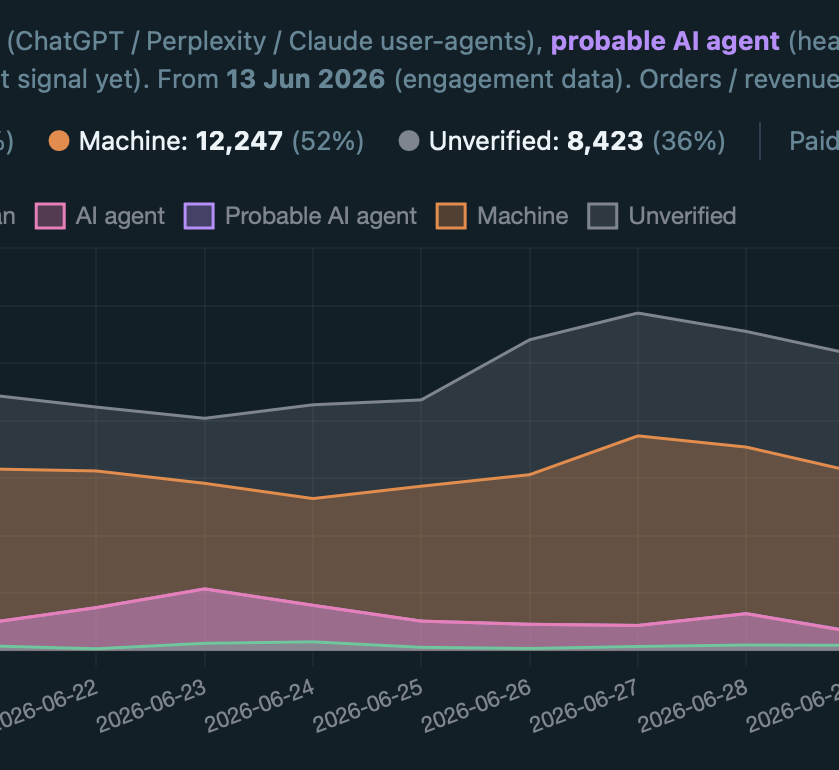
I once wrote about building my own privacy-friendly analytics tool. It had bot detection from the first version, yet it was not enough. Direct visits took a strangely high share of my traffic. When someone claims that 20% of their visits are bots and 80% are humans, I used to think the same. Today I would say the opposite ratio is closer to the truth. This is how I got there.
Seventy per cent. That is where the first AI output begins, even when you give it the full company context and the best examples from the past. We are talking about the kind of output that cannot be defined programmatically. It is more complex. Often it is creative work. On one repeated type of output I reached eighty per cent within a week. Every further percentage point is harder than the one before.
For a long time we treated the internet as the main road. The place where work and relationships happen. Yet most of what we see on it today is, or soon will be, AI-generated: text, images, profiles and comments. The internet is turning into an online game full of bots, where you cannot be sure that a human is on the other side of anything. So I ask: was the online world the main road, or only a temporary detour that part of us will return from, back offline?
A few days ago I interviewed a senior marketer. An experienced man, years of practice. I asked him about AI. He said he barely uses it. He had one bad experience with the output and decided he was too senior for it to add value when it is not perfect. I know the other side too: professionals who automate everything that can be automated.
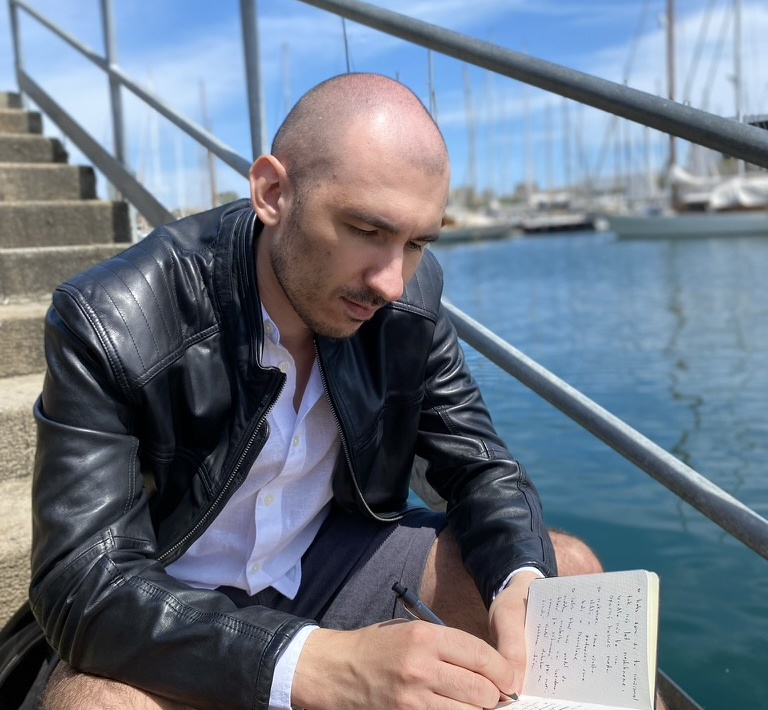
Four days in Catalonia. No computer, no AI, almost no social media. I bought this notebook so that I could write down what I would think about, and what I would come across and learn on the trip.