

Article
Europe Is Not Ready for Drone Warfare

Galați, Romania (EU and NATO territory), 29 May 2026. During the night a Russian drone struck a ten-storey block of flats. A fire broke out on the roof. A 53-year-old woman and a 14-year-old boy were taken to hospital. The drone had been heading for a Ukrainian port.
Romania's foreign minister confirmed the drone was Russian. Moscow denies responsibility and demands an examination. According to Romanian authorities, it was the twenty-eighth time a Russian drone had violated Romanian airspace since Russia began striking Ukrainian ports on the Danube.
The twenty-eighth.
The war has stopped happening 'somewhere over there'. Galați is in the European Union. It is in NATO.
On the night of 9 to 10 September 2025, around twenty Russian drones entered Polish airspace. Allied fighters, mostly Dutch F-35s, shot four of them down. It was the first time during this war that NATO destroyed a Russian asset over alliance territory. Nine days later, three Russian MiG-31s violated Estonian airspace for twelve minutes. Estonia invoked Article 4.
The war already reaches our own territory.
In 2025 Russia sent roughly 54,500 Shahed and Geran drones at Ukraine. By autumn 2025 it was sustaining an average of about 176 long-range drones a day. On the worst days it was far more: in May 2026 the record reached over 1,400 drones in 24 hours.
Those incidents and those numbers should be a warning to us.
We have to build capacity fast, fast enough to defend ourselves against this form of war.
And when you think about how to do it, you realise we are in a worse position than most Europeans admit.
We do not depend on others only to secure our defence today. We depend on others to build that defence in the first place.
Why Europe Cannot Defend Itself
Europe has a problem that money alone cannot solve. It rests on three dependencies, and each one weakens its ability to defend itself.
The first is China, the country that supplies the physical material for defence systems. The second is the United States, the country that supplies the capabilities Europe does not have. The third is ourselves, twenty-seven states that cannot agree how fast, or who pays.
Why Europe Depends on China for Its Defence
The European Union imports about 98 per cent of its rare-earth permanent magnets from China. All of its heavy rare earths. Most of its light ones. They are critical for high-performance drone motors and precision guidance. The Chinese company DJI also holds around 70 per cent of the global drone market and over 90 per cent of the consumer segment.
And here is the uncomfortable part. The same Chinese components power Russian drones too. Ukrainian intelligence estimates that 60 to 65 per cent of the parts in Russian Gerans are of Chinese origin; for critical electronics the estimates climb above 80 per cent. The figures vary by source and should be treated as an intelligence assessment, not hard fact. But the direction is clear.
So China supplies both sides. The drones that fall on European homes, and the factories where Europe would like to build its defence against them.
And China has shown it will use this. In April 2025 it imposed export controls on rare earths. The second wave, from October 2025, it 'suspended', until 10 November 2026. That is not a concession. It holds only as long as it suits China.
One thing is clear: the European Union cannot afford serious friction with China. And China knows it well. It need do nothing. It is enough that it holds the option in its hand. Europe is arming itself to defend against Russia with the permission of a country it does not dare quarrel with.
Join the Library
Full access to my findings, personal stories, and what I learn from the people I meet.
Join the Library · €29.99 per year How a small business, creator or politician can be… What should I study in the age of AI?… I Left My Job for Several Months to Read… How I Fell in Love With Her, at First… How do you stop depending on social media? Can… How to Start With AI in a Company: Automating…Get the full article by email and feel free to reply if you want to discuss it further.
Summary
Common questions on this article's topic
What is EDDI, the European drone wall?
Why does Europe depend on China for defence?
If you have any thoughts, questions, or feedback, feel free to drop me a message at mail@richardgolian.com.
 LinkedIn


Related articles
It happens every day. It is happening right now.
Manipulation without the feeling of being manipulated is the most effective kind.
How can we expect to come to terms with history or learn from it if we do that?
More articles
Are you a content creator playing by the rules of YouTube, Instagram or Google? Are you a small business owner whose business model depends on how often Amazon recommends you, how expensive Facebook ad impressions will be or how expensive Google Ads clicks will be? If all or most of your contact with your audience or customers depends on a big platform showing you to them, you are not in a strong position.
The development of artificial intelligence changes how we look at which paths in life make sense. Which studies and which profession to choose.
It was Thursday, 31 March 2022, when I handed over the last of my responsibilities to my colleagues, closed my laptop and went to the library. I left my job for several months and immersed myself in philosophy. And I am immensely grateful for it. Today I am, like most people, on a merry-go-round, and it is hard for me to stop and think about the fundamental questions of my own life.
It was September 2023. My life, my work, everything was completely different from now. It was simpler. I owned almost nothing. I needed to film an advert, I went up to a floor inside the company where the product I needed for that advert was, and there I noticed her for the first time. She laughs at me when I describe it like this, but at that moment the universe told me, that is her.
How and why I am gradually leaving social media and the big platforms. When I read that Meta is testing a new way to charge for organic posts that link outside its platform, it confirms how right I was to become steadily less dependent on the big platforms and on social media. It does not mean I have left them completely. It means that whether or not I stay in touch with my readers depends on them less and less, and today almost not at all.
One of my family members described a firm that has its data in several different tools, and its employees still join it by hand, in spreadsheets. That is the ordinary state of firms. When somebody tells such people not to do it by hand and to use AI, they will not understand. Most firms do not even have the basic connectors between the tools they use. These firms need help with AI transformation.
The same task, two models. Fable 5 against Opus 4.8. On paper Fable is the better model, with a larger context and stronger specs. And still it lost. Opus handled the task with a single round of checking for 721,000 tokens, while Fable needed nine rounds and burnt through 2.78 million tokens. The difference was not in the model, but in how I set the task. And I know it, because I measured it.
A few weeks ago I installed a small local AI model on my laptop that watches a live camera feed. I turned the webcam on in the dark, and in near total darkness it recognised me and the objects in the room. That such things exist, I have known for a long time. What opened my eyes was the accessibility. I installed it in one prompt, free, and it runs entirely on my machine, sending data nowhere.
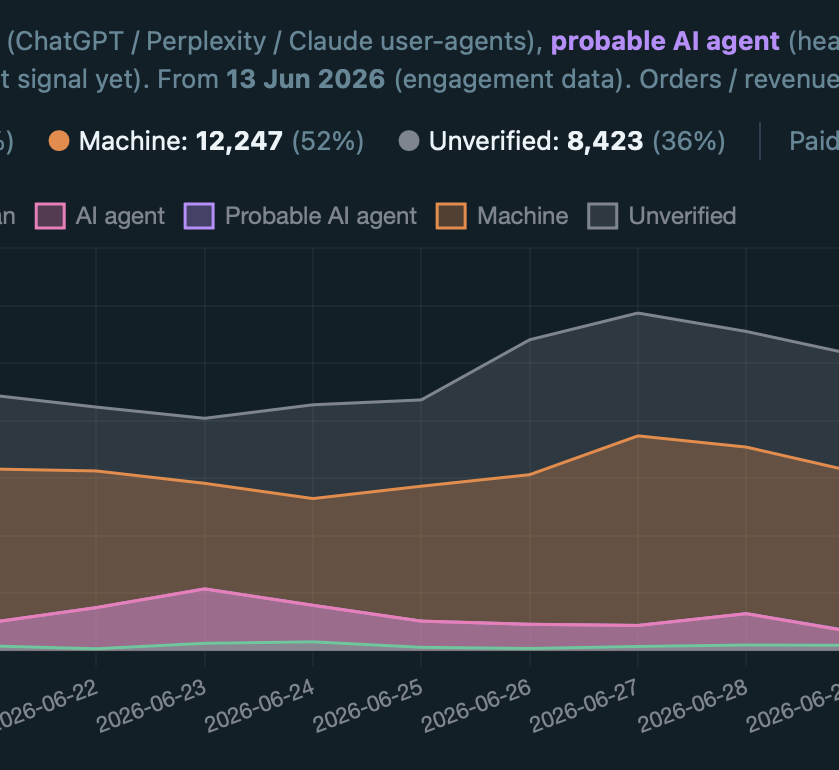
I once wrote about building my own privacy-friendly analytics tool. It had bot detection from the first version, yet it was not enough. Direct visits took a strangely high share of my traffic. When someone claims that 20% of their visits are bots and 80% are humans, I used to think the same. Today I would say the opposite ratio is closer to the truth. This is how I got there.
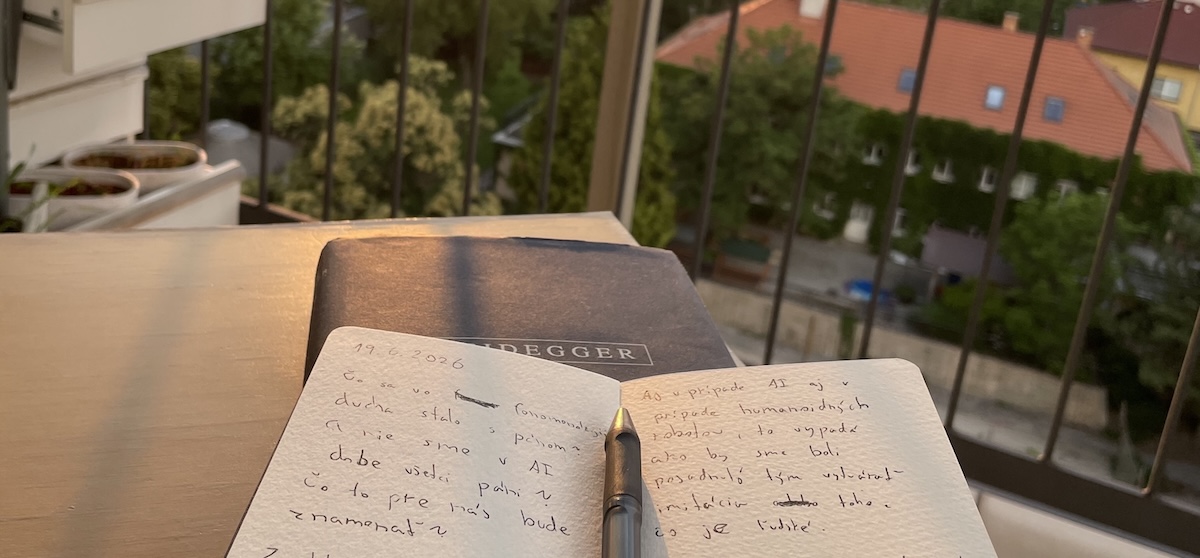
I have Heidegger and my notebook beside me. I am asking where all of this is heading, where artificial intelligence is taking us.
Four days in Catalonia. No computer, no AI, almost no social media. I bought this notebook so that I could write down what I would think about, and what I would come across and learn on the trip.