


Article
Where the Money Goes When AI Takes the Work: Mapping the AI Economy

Prague, 13 May 2026. On my way to work I started thinking about something that stayed with me for days. If most routine work on a computer disappears in the next ten years, and a large share of repetitive manual work disappears with it, what happens to the flow of money?
Who pays whom for what? Which economic layers will exist, how large will they be, and what relationships will run between them?
What Happens to the Economy When AI Takes the Jobs
Around thirty per cent of those who do routine work on a computer lose their position in the medium term. Around seventy per cent in the long term. Across the whole workforce, including jobs that cannot be done on a computer, around fifteen per cent in the medium term, and around thirty per cent in the long term, lose their original job permanently. I have written about that shift before in Will AI Take My Job?. And this still covers only the disappearance of jobs done on a computer.
Add to that a large share of repetitive manual work taken over by robotisation. The wage economy as we know it does not survive. Money has to keep flowing somewhere: earned, spent, taxed, redistributed. Take wage income away from half the population and the cycle breaks at several points at once. The question is what replaces it.
Will Universal Basic Income Solve It? Why the Old Answers Fail
The first reply is that universal basic income will solve it. The problem is that UBI requires the state to tax someone, and the people who would have to be taxed are mostly the same people who write the tax laws. Politicians, lawmakers, central bankers: most of them sit in the top five to ten per cent of capital ownership themselves. Asking them to tax their own capital is asking the carp to drain the pond. France tried a wealth tax. Capital left within years. Corporate tax rates in the EU have fallen for three decades. The largest tax havens in Europe (Ireland, Luxembourg, Cyprus) are EU member states. The OECD global minimum corporate tax sits at fifteen per cent, far below what would be needed to redistribute much.
The second reply is that the market will adjust. But the market can shrink to a hundred million customers and still produce more revenue than today. Apple, Tesla, LVMH, Microsoft can survive serving the top one per cent with custom products and recurring services priced ten or twenty times higher than current consumer models. If a billionaire pays a million dollars a year for a personal security system with thirty robots, a thousand such customers produce the same revenue as a million iPhone buyers, at far higher margins. The middle market is not protected by inevitability. It is a current arrangement that can be abandoned.
The third reply is that pressure from the street will force change. This was true for the last three hundred years of political economy. It is no longer true. With drones, robotic policing, and AI surveillance, the cost of holding power against an unarmed population drops sharply. Capital and political elites no longer need consent to maintain order. They need the technology, and they have it.
The Brakes That Still Hold
None of this means the worst possible outcome is the only outcome. Some brakes still hold.
Technological dependence. Drones, AI, robotic systems all rely on physical infrastructure. Taiwan Semiconductor produces around ninety per cent of the world's advanced chips and depends on twenty-three million Taiwanese people. Power plants need operators. Rare earth materials come from China, Australia, and Myanmar. Datacentres need maintenance crews, engineers, and supply chains. If the upper class discarded everyone else, they would break the systems that hold their own position.
Elites are not united. There are several elites (a US elite, a Chinese elite, an EU elite, a Russian elite, a Gulf elite), each with conflicting interests. Geopolitical competition forces every bloc to keep its population at least loyal on paper, for soldiers, scientists, voters, consumers, and population numbers. No bloc can afford a fully discarded population while the others have not done the same.
Demographic decline. China is at a fertility rate around one. The European Union sits at one and a half. South Korea is below one. The real demographic problem within twenty years is not surplus population but shortage. The fight is more likely to be over how to retain and produce more humans, not how to discard them.
These brakes will not produce utopia. But they will keep the worst version from happening completely.
The Likely Outcome: Gated Luxury Capitalism
The most likely shape of the economy by the mid-2030s is what I would call gated luxury capitalism. A narrow capital class, perhaps one per cent of the world population, owns the AI, infrastructure, land, brands, and distribution channels. They live in protected enclaves with private healthcare, private education, and robotic security. Around them sits a service caste of half a billion to a billion people who keep the system running. Beneath that is a much larger UBI-supported population. And outside the formal money flow is an enormous discarded population in regions where the state has failed or has never functioned.
This is not a forecast in the strict sense. It is the direction the current arrangement points to if no major political force changes it. And no such force is currently visible.
Six Layers of the AI Economy: The New Map
The clearest way to map it is in six layers. These are approximate ranges that overlap and shift at the margins.
Capital. About one per cent of the global population, roughly eighty million people. Owners of AI, infrastructure, real estate, brands, distribution. Geographically mobile. Concentrated in a few dozen enclaves worldwide.
Tech Service. Four to five per cent, around three to four hundred million. Engineers, technicians, datacentre staff, energy operators, biotech researchers, top-tier financial professionals. Located near critical infrastructure.
Local Service. Six to eight per cent, around five to seven hundred million. Hairdressers, therapists, carers, teachers, cooks, couriers, local doctors, physiotherapists, tradesmen. The most stable layer, because what they do cannot be automated within the next decade. They exist wherever there are people to serve.
Universal Basic Income. Twenty-five to thirty-five per cent, two to three billion. In functioning states. Supported by basic income and a healthcare floor.
Join the Library
Full access to my findings, personal stories, and what I learn from the people I meet.
Join the Library · €29.99 per year What should I study in the age of AI?… I Left My Job for Several Months to Read… How I Fell in Love With Her, at First… How do you stop depending on social media? Can… How to Start With AI in a Company: Automating… Fable 5 vs Opus: I Ran the Same Audit…Get the full article by email and feel free to reply if you want to discuss it further.
Summary
Common questions on this article's topic
What happens to the economy when AI replaces most jobs?
Will universal basic income solve AI job loss?
Where will the wealthy live in the AI economy?
What are the six layers of the AI economy?
What is the hybrid strategy for surviving the AI economy?
Can pressure from the public stop this?
Who owns the AI economy?
Which jobs are safe from AI?
Is the AI economy the same as techno-feudalism?
If you have any thoughts, questions, or feedback, feel free to drop me a message at mail@richardgolian.com.
 LinkedIn


Related articles
When someone loses their job, their sense of security collapses, so they sell their stocks.
No matter how I look at the future, I see very few answers and far too many questions and problems.
It is real, growing, and potentially devastating.
More articles
The development of artificial intelligence changes how we look at which paths in life make sense. Which studies and which profession to choose.
It was Thursday, 31 March 2022, when I handed over the last of my responsibilities to my colleagues, closed my laptop and went to the library. I left my job for several months and immersed myself in philosophy. And I am immensely grateful for it. Today I am, like most people, on a merry-go-round, and it is hard for me to stop and think about the fundamental questions of my own life.
It was September 2023. My life, my work, everything was completely different from now. It was simpler. I owned almost nothing. I needed to film an advert, I went up to a floor inside the company where the product I needed for that advert was, and there I noticed her for the first time. She laughs at me when I describe it like this, but at that moment the universe told me, that is her.
How and why I am gradually leaving social media and the big platforms. When I read that Meta is testing a new way to charge for organic posts that link outside its platform, it confirms how right I was to become steadily less dependent on the big platforms and on social media. It does not mean I have left them completely. It means that whether or not I stay in touch with my readers depends on them less and less, and today almost not at all.
One of my family members described a firm that has its data in several different tools, and its employees still join it by hand, in spreadsheets. That is the ordinary state of firms. When somebody tells such people not to do it by hand and to use AI, they will not understand. Most firms do not even have the basic connectors between the tools they use. These firms need help with AI transformation.
The same task, two models. Fable 5 against Opus 4.8. On paper Fable is the better model, with a larger context and stronger specs. And still it lost. Opus handled the task with a single round of checking for 721,000 tokens, while Fable needed nine rounds and burnt through 2.78 million tokens. The difference was not in the model, but in how I set the task. And I know it, because I measured it.
A few weeks ago I installed a small local AI model on my laptop that watches a live camera feed. I turned the webcam on in the dark, and in near total darkness it recognised me and the objects in the room. That such things exist, I have known for a long time. What opened my eyes was the accessibility. I installed it in one prompt, free, and it runs entirely on my machine, sending data nowhere.
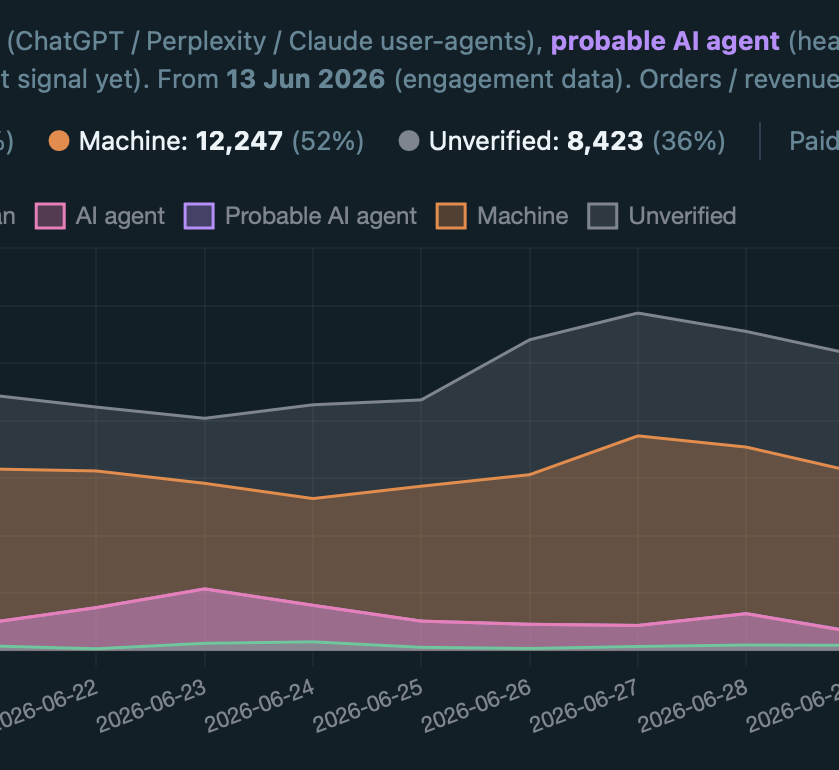
I once wrote about building my own privacy-friendly analytics tool. It had bot detection from the first version, yet it was not enough. Direct visits took a strangely high share of my traffic. When someone claims that 20% of their visits are bots and 80% are humans, I used to think the same. Today I would say the opposite ratio is closer to the truth. This is how I got there.
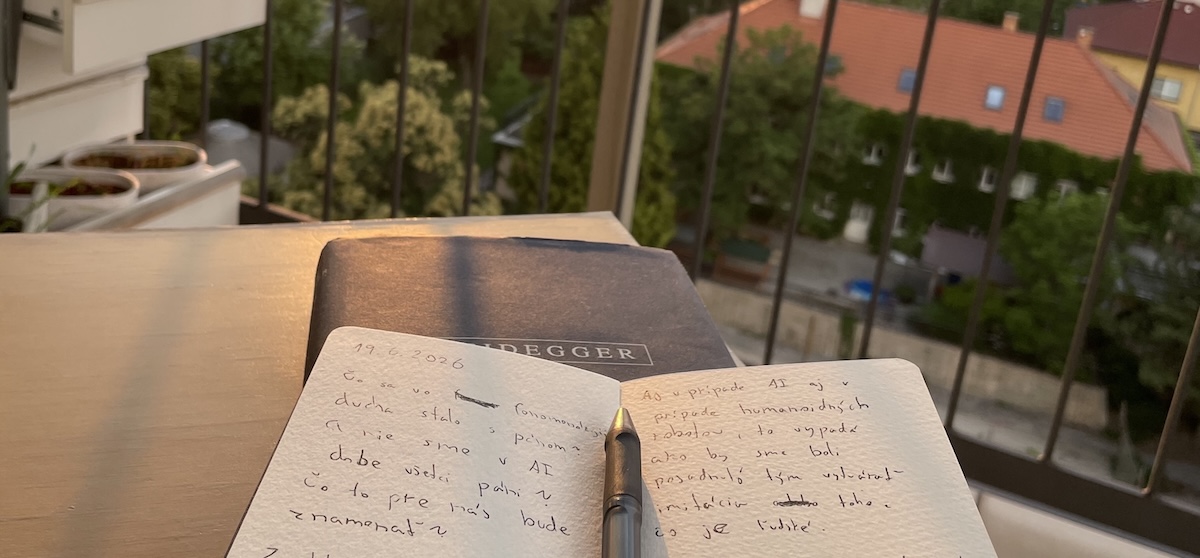
I have Heidegger and my notebook beside me. I am asking where all of this is heading, where artificial intelligence is taking us.
Seventy per cent. That is where the first AI output begins, even when you give it the full company context and the best examples from the past. We are talking about the kind of output that cannot be defined programmatically. It is more complex. Often it is creative work. On one repeated type of output I reached eighty per cent within a week. Every further percentage point is harder than the one before.

Four days in Catalonia. No computer, no AI, almost no social media. I bought this notebook so that I could write down what I would think about, and what I would come across and learn on the trip.