


Article
Open Source Intelligence and AI Crime Detection

Today, I realised how dramatically AI can help in investigating criminal activities through the analysis of publicly available information. When I think about it, investigators, journalists, and state authorities have always relied on their ability to connect information, recognise patterns, and uncover hidden links. But until recently, this was purely human work, slow, exhausting, and dependent on a person’s ability to notice details and combine facts. AI can speed up this process and take it to an entirely new level.
OSINT: Turning Public Data Into Investigative Intelligence
Beneficial Ownership and Corporate Network Analysis
Take business registries, for example. Many countries now have them publicly accessible, and we can search them manually. But what if AI could automatically scan these registries, compare ownership structures, and detect suspicious patterns? What if it could identify that a certain company has an unusually high volume of transactions with another, which is linked to a politically exposed person? Or track how company ownership changes shortly before securing a major government contract? This is already possible today, yet it is not being fully utilised.
Detecting Public Procurement Fraud
The same applies to public procurement. If the same companies repeatedly bid for tenders, if suspiciously similar pricing offers appear, or if an unknown company with minimal history unexpectedly wins, AI could quickly flag these irregularities. People might notice such patterns by chance, but a system that is continuously running and analysing all available data could detect them instantly.
Asset Monitoring and Politically Exposed Persons
Another fascinating use case is AI's ability to monitor the wealth of politicians and business figures. Today, asset declarations exist, but few systematically compare them with reality. What if AI could automatically pull data from land registries, corporate financial statements, and asset disclosures to identify discrepancies? For example, when someone with an officially low income owns luxury real estate or when expensive properties are purchased through a network of obscure companies.
Social Media OSINT and Link Analysis
Then there are social networks. Public posts, photos, location tags. All these are small puzzle pieces that can be assembled into a picture that someone never intended to reveal. AI could identify that two individuals who claim not to know each other actually spent a vacation together. Or that a politician who insists they have never met a particular business owner was in fact present at their private celebration. It is both terrifying and fascinating how much can be reconstructed from publicly available data.
Blockchain Forensics and Anti-Money Laundering
It is not just about politics and corruption. AI can be extremely useful in investigating tax fraud as well. Large-scale money laundering schemes often involve funds moving through dozens of companies in different countries. A human analyst might spend months mapping out these transactions, but AI could accomplish this within minutes. It could track money flows, analyse blockchain transactions, and detect patterns indicative of money laundering.
Mass Surveillance, Deepfakes, and the Collapse of Proof
I also reflect on what impact this could have on society. On one hand, there is enormous potential for uncovering fraud and criminal activity. On the other, there is the issue of privacy and the misuse of power.
Join the Library
Full access to my findings, personal stories, and what I learn from the people I meet.
Join the Library · €29.99 per year What should I study in the age of AI?… I Left My Job for Several Months to Read… How I Fell in Love With Her, at First… How do you stop depending on social media? Can… How to Start With AI in a Company: Automating… Fable 5 vs Opus: I Ran the Same Audit…Get the full article by email and feel free to reply if you want to discuss it further.
Summary
Common questions on this article's topic
How can AI help investigate corruption and financial crime?
Can AI detect irregularities in public procurement?
What is OSINT and how does AI enhance it?
Can AI track money laundering across multiple countries?
What are the risks of AI-powered investigation tools?
Could AI-generated fake evidence undermine investigations?
What is digital forensics and how does AI use it?
What is AI crime detection?
Who uses AI-powered open source intelligence in real investigations?
If you have any thoughts, questions, or feedback, feel free to drop me a message at mail@richardgolian.com.
 LinkedIn


Related articles
You might say I am being too pessimistic, that I am fearmongering. Fear is useful.
No matter how I look at the future, I see very few answers and far too many questions and problems.
It is real, growing, and potentially devastating.
More articles
The development of artificial intelligence changes how we look at which paths in life make sense. Which studies and which profession to choose.
It was Thursday, 31 March 2022, when I handed over the last of my responsibilities to my colleagues, closed my laptop and went to the library. I left my job for several months and immersed myself in philosophy. And I am immensely grateful for it. Today I am, like most people, on a merry-go-round, and it is hard for me to stop and think about the fundamental questions of my own life.
It was September 2023. My life, my work, everything was completely different from now. It was simpler. I owned almost nothing. I needed to film an advert, I went up to a floor inside the company where the product I needed for that advert was, and there I noticed her for the first time. She laughs at me when I describe it like this, but at that moment the universe told me, that is her.
How and why I am gradually leaving social media and the big platforms. When I read that Meta is testing a new way to charge for organic posts that link outside its platform, it confirms how right I was to become steadily less dependent on the big platforms and on social media. It does not mean I have left them completely. It means that whether or not I stay in touch with my readers depends on them less and less, and today almost not at all.
One of my family members described a firm that has its data in several different tools, and its employees still join it by hand, in spreadsheets. That is the ordinary state of firms. When somebody tells such people not to do it by hand and to use AI, they will not understand. Most firms do not even have the basic connectors between the tools they use. These firms need help with AI transformation.
The same task, two models. Fable 5 against Opus 4.8. On paper Fable is the better model, with a larger context and stronger specs. And still it lost. Opus handled the task with a single round of checking for 721,000 tokens, while Fable needed nine rounds and burnt through 2.78 million tokens. The difference was not in the model, but in how I set the task. And I know it, because I measured it.
A few weeks ago I installed a small local AI model on my laptop that watches a live camera feed. I turned the webcam on in the dark, and in near total darkness it recognised me and the objects in the room. That such things exist, I have known for a long time. What opened my eyes was the accessibility. I installed it in one prompt, free, and it runs entirely on my machine, sending data nowhere.
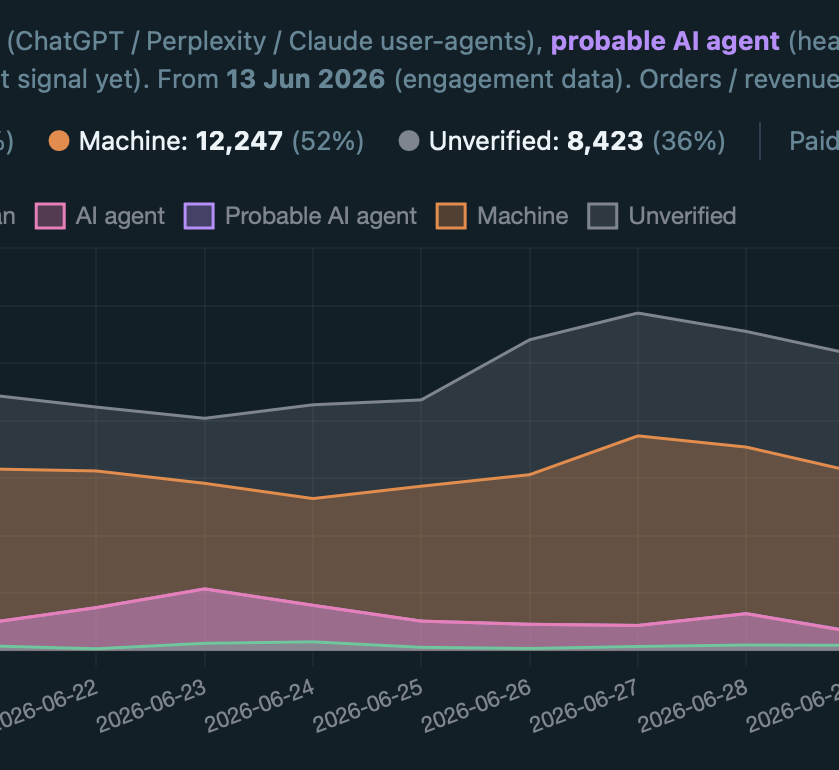
I once wrote about building my own privacy-friendly analytics tool. It had bot detection from the first version, yet it was not enough. Direct visits took a strangely high share of my traffic. When someone claims that 20% of their visits are bots and 80% are humans, I used to think the same. Today I would say the opposite ratio is closer to the truth. This is how I got there.
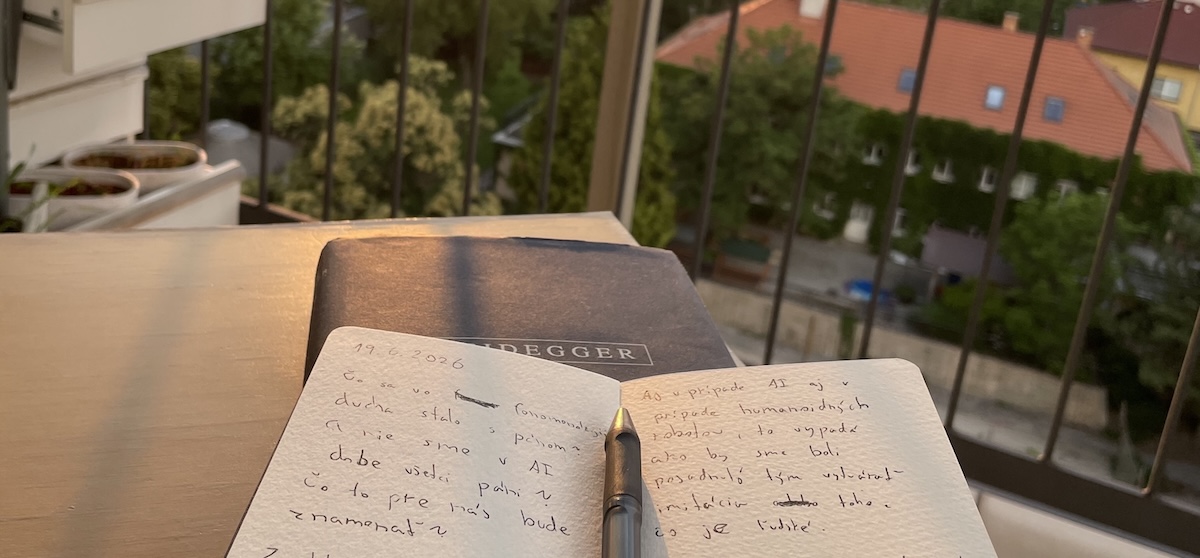
I have Heidegger and my notebook beside me. I am asking where all of this is heading, where artificial intelligence is taking us.
Seventy per cent. That is where the first AI output begins, even when you give it the full company context and the best examples from the past. We are talking about the kind of output that cannot be defined programmatically. It is more complex. Often it is creative work. On one repeated type of output I reached eighty per cent within a week. Every further percentage point is harder than the one before.
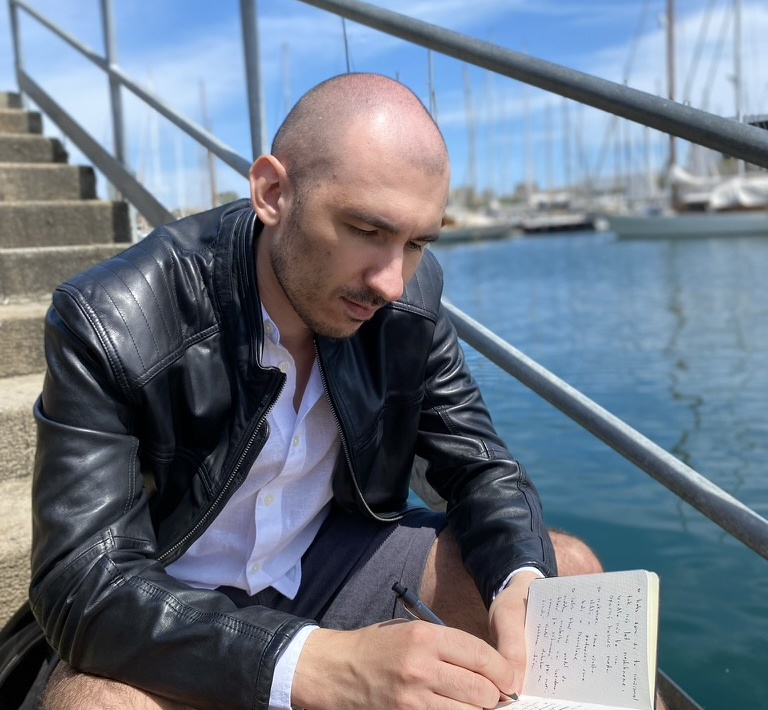
Four days in Catalonia. No computer, no AI, almost no social media. I bought this notebook so that I could write down what I would think about, and what I would come across and learn on the trip.