

Article
Robert Fico Forgets When and How the Second World War Began

A few days ago, Robert Fico said:
“Dear Ambassador of the Russian Federation to Slovakia, I will say this honestly and from the heart. And I am not exaggerating. I am very glad to be among normal people. We don’t often have the opportunity to meet people who know exactly what happened between 1941 and 1945.”
In the same speech, he added:
“There’s a wise saying that reminds us: those who forget history or refuse to learn it are condemned to see it repeated.”
So let me remind Mr. Fico of the history he conveniently forgot or does not wish to acknowledge.
When he speaks of the Second World War, he seems to overlook when and how it actually began:
-
The Second World War started on September 1, 1939, when Germany and Slovakia militarily invaded Poland.
-
On September 17, 1939, the Soviet Union joined the invasion of Poland.
I honestly do not understand how, in today’s world, we cannot call things by their real names and instead twist or forget the most basic historical facts. How can we expect to come to terms with history or learn from it if we do that?
It is simple: the Second World War began with the invasion of Poland, in which the Soviet Union participated, coordinating its efforts with Germany. Slovakia was part of that invasion from day one. And I do not need a book or Wikipedia to remember that. My great-grandfather was deployed as a soldier on the Polish border at the time.
Continue reading for free
Enter your email to keep reading for free. This also subscribes you to my monthly newsletter. No spam, unsubscribe anytime.
Sources
Summary
Common questions on this article's topic
When did the Second World War actually begin?
Did Slovakia participate in the invasion of Poland in 1939?
Did Slovakia pay to deport its Jewish population?
What was the Slovak National Uprising?
Did the Slovak president award medals to those who suppressed the uprising?
Why does selective historical memory matter?
If you have any thoughts, questions, or feedback, feel free to drop me a message at mail@richardgolian.com.
 LinkedIn


Related articles
It happens every day. It is happening right now.
Manipulation without the feeling of being manipulated is the most effective kind.
Europe does not have the capacity to face a full-scale, mass drone war of the kind we see in Ukraine. Three dependencies weaken it: China supplies the physical material for defence systems, the United States supplies capabilities Europe does not have, and twenty-seven states cannot agree how fast, or who pays. Rearmament plans exist, but they are being carried out slowly.
More articles
It was September 2023. My life, my work, everything was completely different from now. It was simpler. I owned almost nothing. I needed to film an advert, I went up to a floor inside the company where the product I needed for that advert was, and there I noticed her for the first time. She laughs at me when I describe it like this, but at that moment the universe told me, that is her.
How and why I am gradually leaving social media and the big platforms. When I read that Meta is testing a new way to charge for organic posts that link outside its platform, it confirms how right I was to become steadily less dependent on the big platforms and on social media. It does not mean I have left them completely. It means that whether or not I stay in touch with my readers depends on them less and less, and today almost not at all.
One of my family members described a firm that has its data in several different tools, and its employees still join it by hand, in spreadsheets. That is the ordinary state of firms. When somebody tells such people not to do it by hand and to use AI, they will not understand. Most firms do not even have the basic connectors between the tools they use. These firms need help with AI transformation.
The same task, two models. Fable 5 against Opus 4.8. On paper Fable is the better model, with a larger context and stronger specs. And still it lost. Opus handled the task with a single round of checking for 721,000 tokens, while Fable needed nine rounds and burnt through 2.78 million tokens. The difference was not in the model, but in how I set the task. And I know it, because I measured it.
A few weeks ago I installed a small local AI model on my laptop that watches a live camera feed. I turned the webcam on in the dark, and in near total darkness it recognised me and the objects in the room. That such things exist, I have known for a long time. What opened my eyes was the accessibility. I installed it in one prompt, free, and it runs entirely on my machine, sending data nowhere.
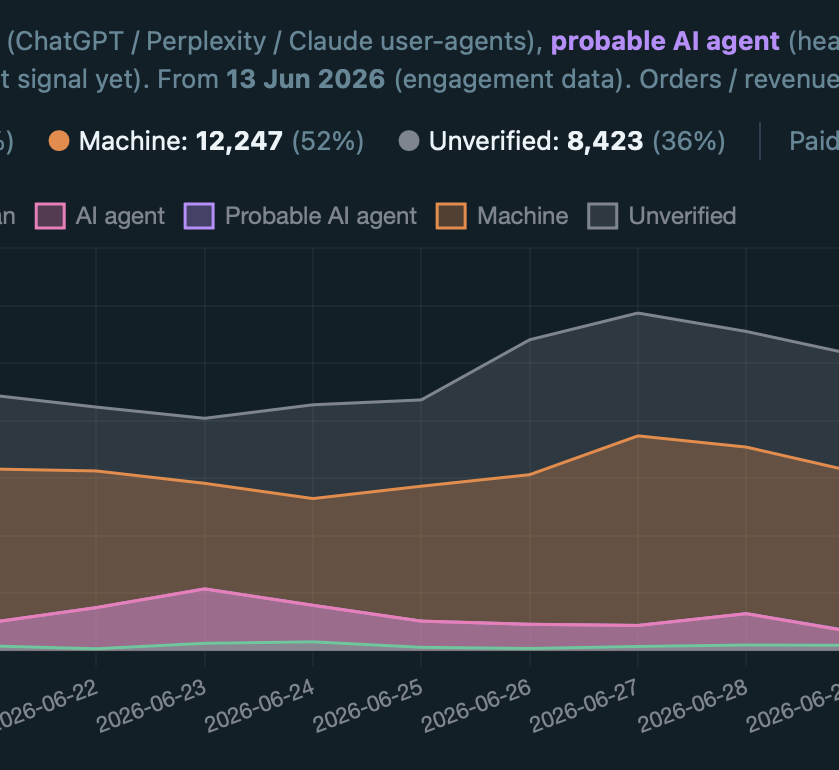
I once wrote about building my own privacy-friendly analytics tool. It had bot detection from the first version, yet it was not enough. Direct visits took a strangely high share of my traffic. When someone claims that 20% of their visits are bots and 80% are humans, I used to think the same. Today I would say the opposite ratio is closer to the truth. This is how I got there.
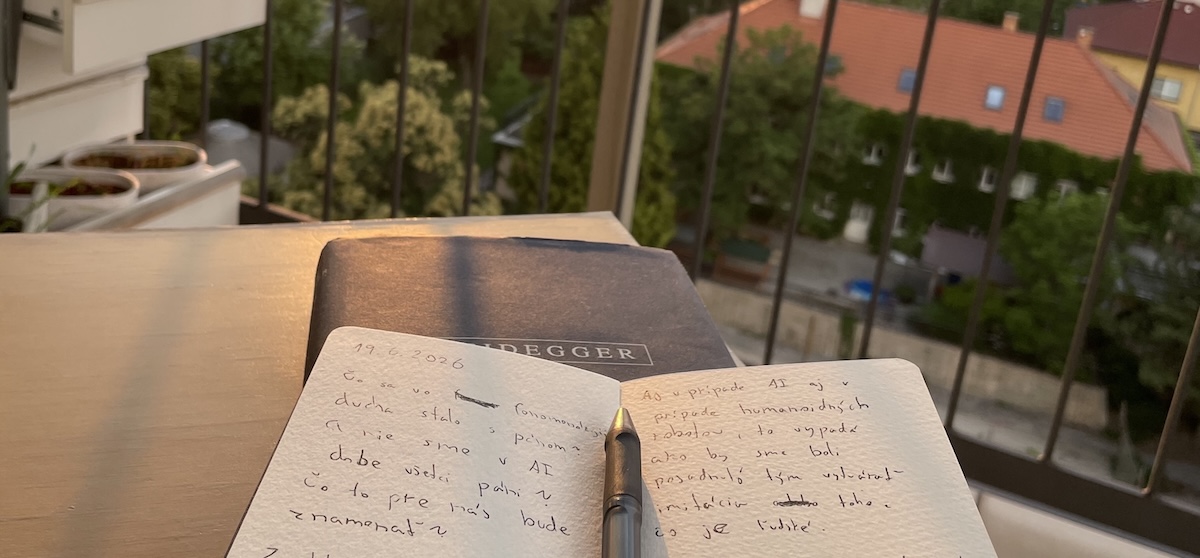
I have Heidegger and my notebook beside me. I am asking where all of this is heading, where artificial intelligence is taking us.
Seventy per cent. That is where the first AI output begins, even when you give it the full company context and the best examples from the past. We are talking about the kind of output that cannot be defined programmatically. It is more complex. Often it is creative work. On one repeated type of output I reached eighty per cent within a week. Every further percentage point is harder than the one before.
For a long time we treated the internet as the main road. The place where work and relationships happen. Yet most of what we see on it today is, or soon will be, AI-generated: text, images, profiles and comments. The internet is turning into an online game full of bots, where you cannot be sure that a human is on the other side of anything. So I ask: was the online world the main road, or only a temporary detour that part of us will return from, back offline?
A few days ago I interviewed a senior marketer. An experienced man, years of practice. I asked him about AI. He said he barely uses it. He had one bad experience with the output and decided he was too senior for it to add value when it is not perfect. I know the other side too: professionals who automate everything that can be automated.
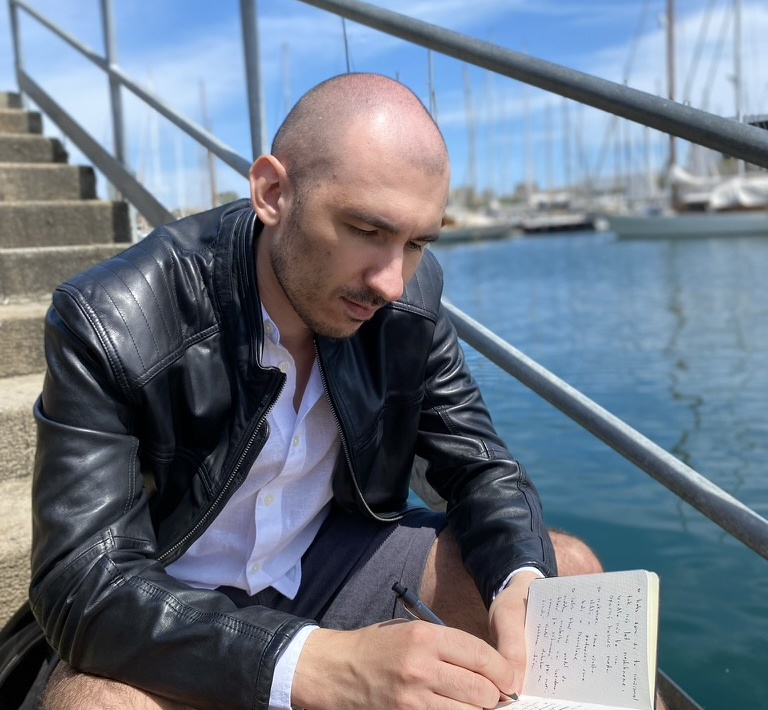
Four days in Catalonia. No computer, no AI, almost no social media. I bought this notebook so that I could write down what I would think about, and what I would come across and learn on the trip.