


Article
Best Philosophy Books That Changed How I Think

Since my early childhood, I have been an avid reader. Looking back, I consider myself an ideal child: asleep, playing alone, or immersed in books. Reflecting on this, not much has changed over the past 28 years.
Interestingly, I did not require a vast collection of books; I sought out the ones I found most intriguing. This approach seemed logical. Why settle for less when you can enjoy the best available? Although I cannot recall the first book that captivated me, by the time I entered elementary school, a book about mammals had become my constant companion. I read it so frequently that the cover fell apart. I memorized facts about various mammals, including their characteristics and habitats.
However, the advent of the Internet marked a decline in my book reading. Technology utterly fascinated me, and at 12, I dedicated a summer to learning web development. This phase of my life, misunderstood by my family as mere gaming, was an enriching learning experience. I may share more about that period in a future post.
End of High School and Return to Books
As I contemplated my university studies, despite my experience as a freelance web developer and creator of several projects, I grew disinterested in coding. I chose to study International Relations, Politics, and Philosophy at Charles University.
The preparation for university admissions led me to disconnect from the Internet and retreat to the science library in my hometown, Banská Bystrica. That year was one of the best in my life, offering me the tranquillity and time to delve into topics of great interest to me, such as the chronologies of critical historical events in Western civilization and the exploration of historical maps. This period felt like a rebirth.
My blog page originated shortly after, documenting my growing fascination with knowledge approaches and phenomenology, especially during my master's studies, which bridged science and philosophy.
Books That Most Changed My Outlook on Life and the World
My childhood habit of re-reading favourite books has persisted, leading me to revisit many titles multiple times, with plans to re-read especially compelling sections. I have ranked these books by my current preference.
- 8. Apology of Socrates (Ἀπολογία Σωκράτους) by Plato
This text offers Plato's rendition of Socrates' defence before his condemnation to death. I recommend it to everyone for its unparalleled impact on Western thought.
- 7. On the Essence of Truth (Vom Wesen der Wahrheit) by Martin Heidegger
Engaging with this text was a formidable challenge, requiring two years of intensive study at Charles University, after which I felt I had barely scratched the surface. Approach with caution due to its complexity.
- 6. The Phenomenology of Spirit (Phänomenologie des Geistes) by Georg Wilhelm Friedrich Hegel
This work comes with a dual warning: its complexity and the irreversible change in perspective it offers, primarily through its analysis of the Dialectic of Lord and Bondsman.
- 5. Practice in Christianity (Indøvelse i Christendom) by Søren Kierkegaard
More than a discourse on faith, this work presents a reflective critique of the times, including the consequences of Hegel's rationality and the approach of modern science, offering a perspective that resonates beyond religious boundaries.
- 4. Gorgias (Γοργίας) by Plato
I recommend it to everyone. Read it!
- 3. Truth and Method (Wahrheit und Methode) by Hans-Georg Gadamer
A book that deepens the reader's understanding of philosophical and scientific discussions, suitable for readers across the spectrum of expertise.
- 2. Being and Time (Sein und Zeit) by Martin Heidegger
It is a monumental text that I have engaged with extensively, revisiting specific passages nearly a hundred times. I caution potential readers about its complexity. It transcends ordinary understanding, requiring guidance from those experienced in Heidegger's thought.
I mentioned certain passages from this book in a post about the meaning of life in the age of artificial intelligence.
- 1. Personal writings by Marcus Aurelius
My copy, brimming with annotations and quotes from other Roman thinkers, is a testament to my journey with this book. I recommend it to everyone.
What My Copy of Marcus Aurelius Actually Looks Like
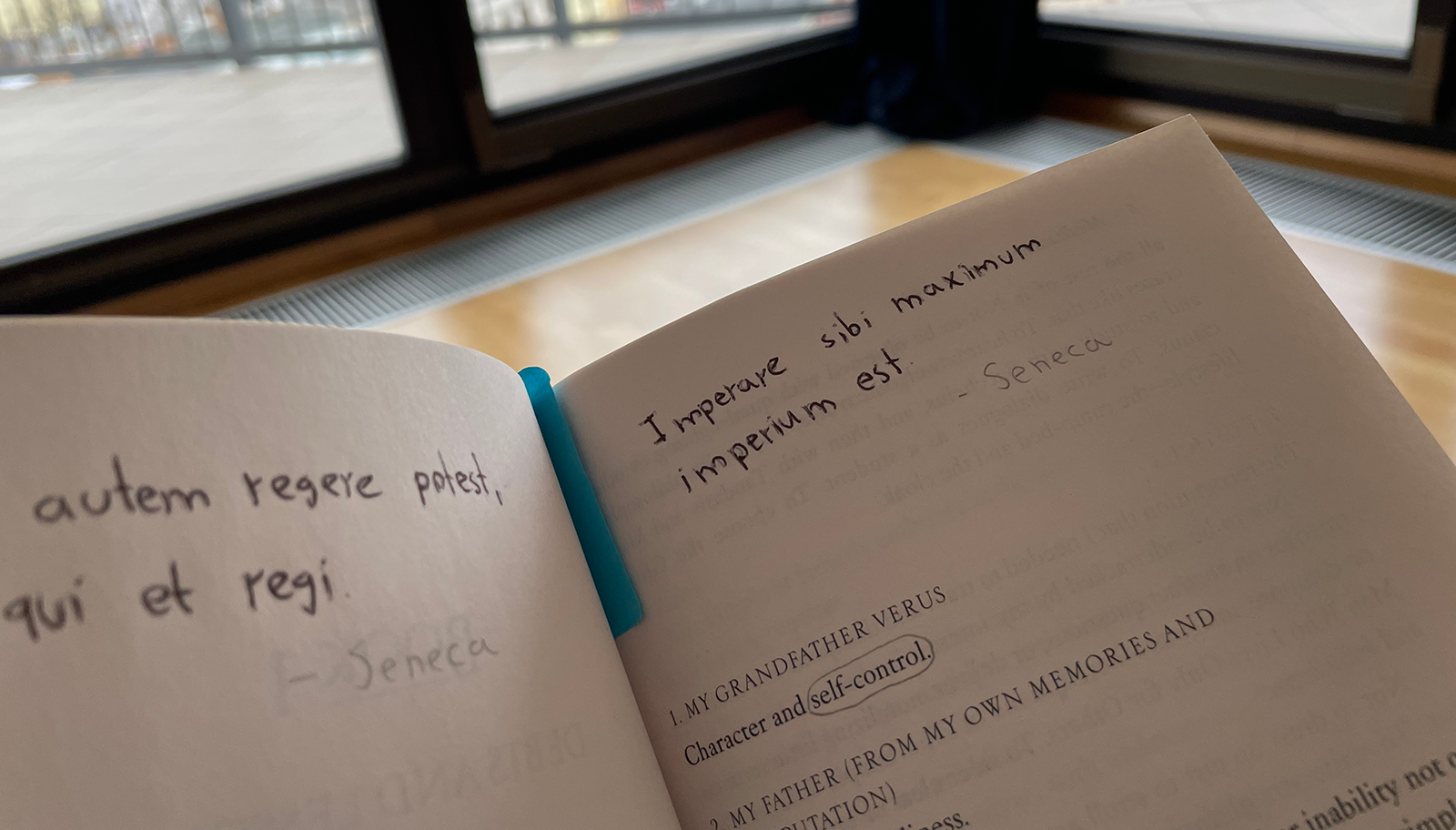
The first page seemingly has nothing to do with Marcus Aurelius. It is covered in quotes from Cicero and Quintilian that I wrote there before I even started reading.
Sine philosophia non posse effici quem quaerimus eloquentem. Without philosophy, one cannot become the orator we seek. Cicero. Then Quintilian: Quare non, ut intellegere possit, sed, ne omnino possit non intellegere, curandum. The concern is not that the listener might understand, but that he cannot possibly fail to understand.
Join the Library
Full access to my findings, personal stories, and what I learn from the people I meet.
Join the Library · €29.99 per year How I Fell in Love With Her, at First… How do you stop depending on social media? Can… How to Start With AI in a Company: Automating… Fable 5 vs Opus: I Ran the Same Audit… I Ran Object Detection on My Laptop, and Saw… Bot or Human? What My…Get the full article by email and feel free to reply if you want to discuss it further.
Summary
Common questions on this article's topic
What is Marcus Aurelius' Meditations about?
Why is Heidegger's Being and Time considered so important?
How can reading ancient philosophy change your perspective on modern life?
What is the Master-Slave dialectic in Hegel's Phenomenology of Spirit?
What are the best philosophy books for beginners to start with?
If you have any thoughts, questions, or feedback, feel free to drop me a message at mail@richardgolian.com.
 LinkedIn


Related articles
What is artificial intelligence? In plain terms, it is applied mathematics that predicts the most probable next word in a sequence. It does not think, and it does not understand. When we hear the phrase, many people imagine something mysterious, something that thinks, something that understands. It does not. I work with AI every day, and the more I use it, the clearer the truth becomes: it predicts what the next word should be. That is the entire mechanism.
If I have learned anything from this experience, it is that my life is not driven by something predefined.
When this sense of meaning disappears, it leaves behind an emptiness that most people find difficult to bear.
More articles
It was September 2023. My life, my work, everything was completely different from now. It was simpler. I owned almost nothing. I needed to film an advert, I went up to a floor inside the company where the product I needed for that advert was, and there I noticed her for the first time. She laughs at me when I describe it like this, but at that moment the universe told me, that is her.
How and why I am gradually leaving social media and the big platforms. When I read that Meta is testing a new way to charge for organic posts that link outside its platform, it confirms how right I was to become steadily less dependent on the big platforms and on social media. It does not mean I have left them completely. It means that whether or not I stay in touch with my readers depends on them less and less, and today almost not at all.
One of my family members described a firm that has its data in several different tools, and its employees still join it by hand, in spreadsheets. That is the ordinary state of firms. When somebody tells such people not to do it by hand and to use AI, they will not understand. Most firms do not even have the basic connectors between the tools they use. These firms need help with AI transformation.
The same task, two models. Fable 5 against Opus 4.8. On paper Fable is the better model, with a larger context and stronger specs. And still it lost. Opus handled the task with a single round of checking for 721,000 tokens, while Fable needed nine rounds and burnt through 2.78 million tokens. The difference was not in the model, but in how I set the task. And I know it, because I measured it.
A few weeks ago I installed a small local AI model on my laptop that watches a live camera feed. I turned the webcam on in the dark, and in near total darkness it recognised me and the objects in the room. That such things exist, I have known for a long time. What opened my eyes was the accessibility. I installed it in one prompt, free, and it runs entirely on my machine, sending data nowhere.
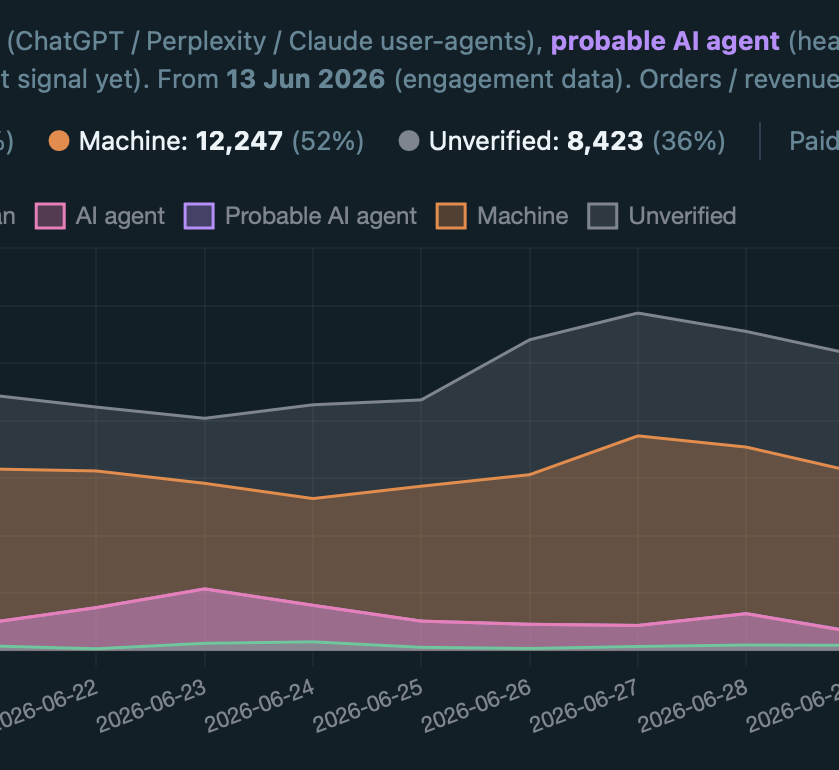
I once wrote about building my own privacy-friendly analytics tool. It had bot detection from the first version, yet it was not enough. Direct visits took a strangely high share of my traffic. When someone claims that 20% of their visits are bots and 80% are humans, I used to think the same. Today I would say the opposite ratio is closer to the truth. This is how I got there.
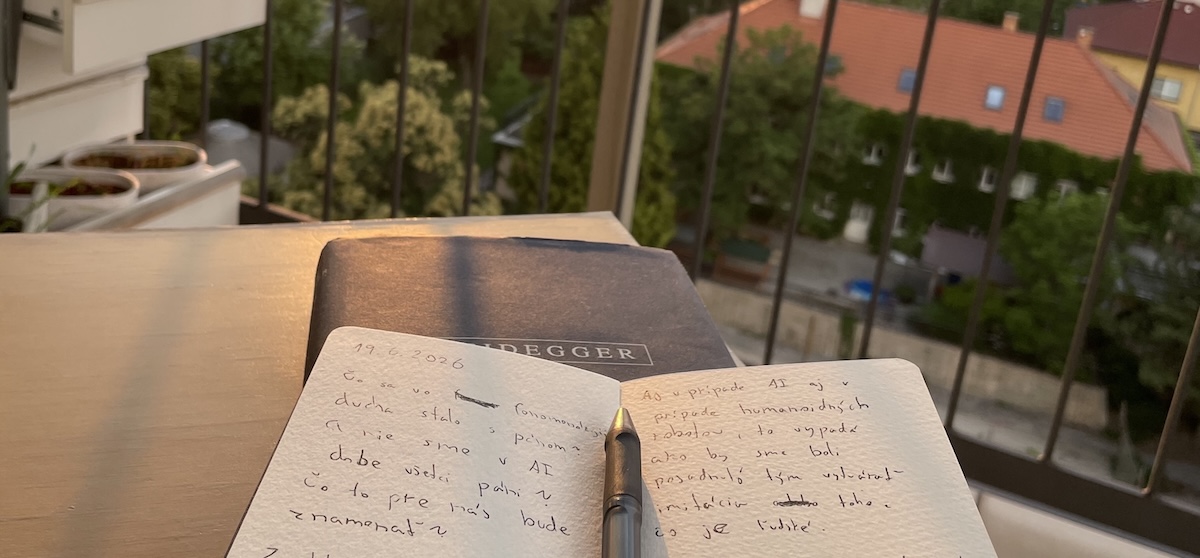
I have Heidegger and my notebook beside me. I am asking where all of this is heading, where artificial intelligence is taking us.
Seventy per cent. That is where the first AI output begins, even when you give it the full company context and the best examples from the past. We are talking about the kind of output that cannot be defined programmatically. It is more complex. Often it is creative work. On one repeated type of output I reached eighty per cent within a week. Every further percentage point is harder than the one before.
For a long time we treated the internet as the main road. The place where work and relationships happen. Yet most of what we see on it today is, or soon will be, AI-generated: text, images, profiles and comments. The internet is turning into an online game full of bots, where you cannot be sure that a human is on the other side of anything. So I ask: was the online world the main road, or only a temporary detour that part of us will return from, back offline?
A few days ago I interviewed a senior marketer. An experienced man, years of practice. I asked him about AI. He said he barely uses it. He had one bad experience with the output and decided he was too senior for it to add value when it is not perfect. I know the other side too: professionals who automate everything that can be automated.
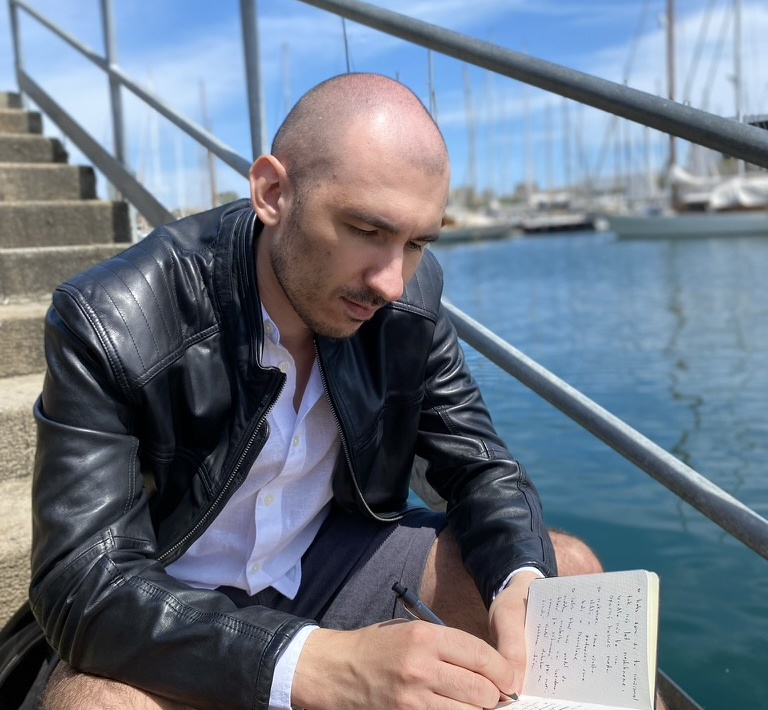
Four days in Catalonia. No computer, no AI, almost no social media. I bought this notebook so that I could write down what I would think about, and what I would come across and learn on the trip.