



Article
We Are Weak and They Know It: The Manipulation Tactics That Work

I am writing this post primarily for myself, as a map of the traps built into today's world. A way to navigate it more clearly. This is a mental exercise for me.
The environment we live in today is not natural to us. It has been optimised for manipulation. It was built through the internet, social media, and the surrender of our privacy.
We are predictable. Not as individuals, but as masses.
Not because we are stupid.
Not because we are inferior.
But because we are living creatures with certain traits hardwired by evolution.
They know this well.
Those who hold power often understand one fundamental thing, the weakness of human nature. On that weakness, you can build a business, a marketing strategy, a political campaign, or a system of manipulation.
We have a brain that evolved for hundreds of thousands of years in conditions dramatically different from today. We have instincts designed for survival. We have needs that once held us together as a tribe. We have mental shortcuts meant to save energy.
But today, the mechanisms that helped us survive are turning into vulnerabilities.
An Evolutionary Disadvantage in the Modern World
Imagine a human being 50,000 years ago.
They live in a small group. They know everyone. They know who is strong, who is reliable, who is dangerous. Food is limited. Every unit of energy matters. Every mistake, like failing to react to a threat, can mean death. Every threat is physical and immediate: a predator, a hostile group, hunger, disease. Information spreads slowly, orally, in person, inside a small community.
The brain optimised for:
- seeking calorie-dense food
- fast, strong threat response
- belonging to a group
These mechanisms were an advantage.
The one who reacted quickly to a rustle in the grass survived.
The one who stayed close to the group survived.
The brain learned to save energy and rely on shortcuts. Trust familiar faces. React to strong emotions.
Today:
- food is everywhere
- threats are often informational, not physical
- groups are often closed opinion bubbles, cults, or sects, mostly in the digital space
The threat is no longer a lion. It is a headline. It is a notification. It is a message engineered to trigger fear.
Belonging once meant physical protection. Today it often means approval through likes, identity confirmation, opinion confirmation.
We live in a world that changes faster than humans do.
Ultra-Processed Food and the Brain's Reward System
Let us start with something that seems banal: food.
Our bodies respond strongly to sugar and fat. Those who could find calorie-rich food had a higher chance of survival.
The body built a strong reward response around them. When we found something sweet or fatty, the reward system activated. That system existed to make sure we remembered the experience and repeated it.
But today we do not live in scarcity. We live in excess.
The largest food companies invest enormous resources into researching which combination of taste and texture produces the highest customer satisfaction, so they buy again. So the reward system sends the signal: do it again. At the same time, they optimise costs: shelf life, storage, logistics. This drives the growth of ultra-processed foods with minimal nutritional value.
Their availability and addictive design lead to overeating and health problems. Our mind does not treat calorie surplus as a danger. It treats available energy as an opportunity.
I have written before about how almost completely cutting these foods out eliminated my health issues.
I saw firsthand that what once built us up now makes us dependent on healthcare, medication, and supplements.
What once strengthened us now wears us down. And it does not stop with food.
Kompromat: Sex, Pornography and Blackmail as Power
This is one of the oldest mechanisms we have. Evolutionarily, it ensures reproduction. Which is why its motivational force is extreme. The brain responds to sexual stimuli intensely, especially when novelty and visual stimulation are involved.
In the digital environment, sex is available in almost unlimited quantities, the way calorie-dense food is in supermarkets. Pornography attacks this drive directly. The brain can respond to digital novelty even more intensely than to the natural context of a relationship, because the digital environment enables infinite variation of stimuli.
The problem is not sexuality itself. Sexuality is a natural part of being human. The problem begins when our intimate life becomes recordable, and archivable. That creates a new kind of vulnerability, one that is systematically exploited today.
Imagine a person with a certain status. A public image, a family, a career, political or economic power. Their credibility is part of their capital. If they get involved in something that should not be public, an information asymmetry emerges. Someone knows something the public does not. And the moment there is evidence (a recording, a photo, a message), leverage appears.
A strong drive can lead to creating material that becomes a reputational risk. And reputational risk can be used for pressure or blackmail. The pressure does not even have to be explicit. It is enough that it is silently understood: we know about you.
Technological progress has amplified this vulnerability dramatically. Today it is possible to record communication discreetly, store data, archive private moments. The cost of compromising someone is lower than at any point in history. Technology lowers barriers. And when a powerful biological drive meets low recording barriers and high reputational value, a mechanism emerges that can be exploited systematically.
A biological instinct becomes a tool of control. It is a power mechanism that often influences companies, states, international organisations, and scientific circles, and therefore has a real impact on all of our lives. There are individuals and entities whose business and power are built on this, on one of our greatest vulnerabilities.
Again: what once helped preserve the species and build stronger communities becomes a weakness today, and therefore a tool of power and control.
And this is only one of many ways it happens.
Loss Aversion, Scarcity Marketing and Gambling
Many of today's traps attack our financial health.
People do not respond symmetrically to gains and losses. Loss hurts more than gain pleases, a phenomenon described in the Nobel Prize-winning research of Daniel Kahneman. The prospect of losing hits us harder than an equivalent gain.
This is exploited deliberately. That is why tactics like "only a few left in stock" or "12 people are viewing this product right now" work. Artificial urgency reduces the time available for rational decision-making. When a person feels they might lose something, they act faster and think less. We shift into loss-prevention mode, not analysis mode. In that state we do not calculate long-term consequences. We react impulsively.
But there are also traps built on hope. Gambling promises a shortcut. It promises to skip the long and difficult process of building value. Mathematics is ruthless. In the long run, the house always wins.
Commercial marketing and gambling systematically extract money from our wallets. Not randomly. Using well-documented patterns in how we think and behave. Combined with financial illiteracy, this makes the poor poorer and creates a cycle that is very difficult to escape.
Mass behaviour is predictable. And where behaviour is predictable, it can be modelled. And what can be modelled can be optimised, monetised, or otherwise exploited.
Fear Mongering and Outrage in Political Marketing
Modern digital platforms do not display content based on truthfulness or quality. The algorithm rewards content that captured attention and triggered a response, a click, a comment, a share.
And what generates the strongest reactions? Emotions. For example: anger.
Anger is mobilising. In an evolutionary context, it signalled readiness for conflict. It activates the body, accelerates response. But it also weakens analytical thinking. When we are angry, we react faster but think less.
Content designed to provoke outrage exploits this precisely. It triggers the sense that "this is unacceptable", "this must be stopped", "this is an attack on us." It often works with extremes, oversimplifications, or things stripped of context. Provocative headlines, reductive interpretations, deliberately inflammatory framing, all with one goal: an immediate emotional reaction.
An angry person clicks more. Comments more. Shares more. And thereby increases the reach of the content that angered them. Outrage becomes the engine of the attention economy. It generates attention, generates profit, and deepens social polarisation. Groups seal themselves into opinion bubbles. Criticism becomes attack. Discussion becomes combat.
Even stronger than anger is fear.
Fear runs even deeper evolutionarily. When we are afraid, the brain shifts into defensive mode. Areas responsible for rapid threat response activate. In a state of fear, we do not seek complex solutions. We seek protection. Certainty. Someone or something to "fix it."
Political marketing built on fear targets the survival instinct and the need for safety. The threat does not need to be imminent. It does not even need to be as real as it is presented. When we feel threatened, we are more willing to accept information that offers a quick sense of orientation and safety, even if that information is inaccurate or misleading.
Conspiracy Theories and the Need for a Scapegoat
Conspiracies attack the threat instinct, the need to understand the world, and the need to find someone to blame. They offer a simple explanation for complex events and a clearly named enemy. They give the sense that chaos has a hidden order, and that someone knows "the real truth."
When simple stories, half-truths, falsehoods, and conspiracies begin spreading unchecked, a broader problem emerges.
Information Chaos
Information chaos diverts attention from verifiable facts, and this state is often precisely the goal of various state and non-state actors. When the space is flooded with extreme claims, rational discourse disappears. Chaos is easier to manipulate within. The less we believe that anything can be known, the more readily we accept emotional narratives instead of facts. And the more easily we conform to whichever group offers us at least some framework.
Cults, Groupthink and the Culture War
In chaos, people naturally turn to their group. The need to belong is ancient. It worked because group loyalty increased the chances of survival. Alone in nature, a person rarely survived. The group meant safety.
Today this need leads to polarisation and blind trust. The cult is a prime example: a strong leader, a clear enemy, a simple story, gradual isolation from alternative perspectives.
When identity becomes fused with an opinion, criticism of that opinion is experienced as an attack on the person. And at that point, rationality retreats.
The need to be part of a community can be exploited through cult dynamics and strong group identity. A person then stops searching for truth and starts searching for safety. Not for correct answers, but for their place in the group.
This bias can be exploited through culture wars. When people split into camps, truth becomes irrelevant. What matters is who said it and which side they are on.
Every person has their own filters, their own traumas, their own need for recognition or status. And those filters can be targeted with precision.
Astroturfing: The Illusion of Spontaneous Support
When we see that "everyone" believes something, we tend to conform. Social proof is a powerful mechanism. It is exploited by creating the impression of grassroots support, coordinated accounts, artificially amplified content, campaigns designed to look organic.
Choice Architecture: When You Think You Decided for Yourself
The most sophisticated mechanism is not coercion. It is the design of the environment.
If someone selectively provides you with information, frames the interpretation, highlights the risks, and suppresses the alternatives, you might decide exactly as intended. And you will feel free.
Manipulation without the feeling of being manipulated is the most effective kind.
Cognitive Biases: The Mechanisms of Manipulation
We do not experience the world like a computer processing all data objectively and without emotion.
Join the Library
Full access to my findings, personal stories, and what I learn from the people I meet.
Join the Library · €29.99 per year How do you stop depending on social media? Can… How to Start With AI in a Company: Automating… Fable 5 vs Opus: I Ran the Same Audit… I Ran Object Detection on My Laptop, and Saw… Bot or Human? What My… Dependent on AI: Are We…Get the full article by email and feel free to reply if you want to discuss it further.
Sources
Summary
Common questions on this article's topic
Why are humans so vulnerable to manipulation in the modern world?
What is confirmation bias and how do algorithms exploit it?
What is the anchoring effect and how is it used in manipulation?
Why do repeated lies eventually start to feel true?
What is astroturfing and how does it create false consensus?
How can someone make you believe you made a free choice when you did not?
What is cognitive dissonance?
What is loss aversion?
What is priming?
What is social proof?
What is groupthink?
What is kompromat?
What are psyops?
How can you protect yourself from manipulation?
If you have any thoughts, questions, or feedback, feel free to drop me a message at mail@richardgolian.com.
 LinkedIn


Related articles
Before you can teach AI to understand anything, you need to see what it is hiding from you.
It happens every day. It is happening right now.
How can we expect to come to terms with history or learn from it if we do that?
More articles
How and why I am gradually leaving social media and the big platforms. When I read that Meta is testing a new way to charge for organic posts that link outside its platform, it confirms how right I was to become steadily less dependent on the big platforms and on social media. It does not mean I have left them completely. It means that whether or not I stay in touch with my readers depends on them less and less, and today almost not at all.
One of my family members described a firm that has its data in several different tools, and its employees still join it by hand, in spreadsheets. That is the ordinary state of firms. When somebody tells such people not to do it by hand and to use AI, they will not understand. Most firms do not even have the basic connectors between the tools they use. These firms need help with AI transformation.
The same task, two models. Fable 5 against Opus 4.8. On paper Fable is the better model, with a larger context and stronger specs. And still it lost. Opus handled the task with a single round of checking for 721,000 tokens, while Fable needed nine rounds and burnt through 2.78 million tokens. The difference was not in the model, but in how I set the task. And I know it, because I measured it.
A few weeks ago I installed a small local AI model on my laptop that watches a live camera feed. I turned the webcam on in the dark, and in near total darkness it recognised me and the objects in the room. That such things exist, I have known for a long time. What opened my eyes was the accessibility. I installed it in one prompt, free, and it runs entirely on my machine, sending data nowhere.
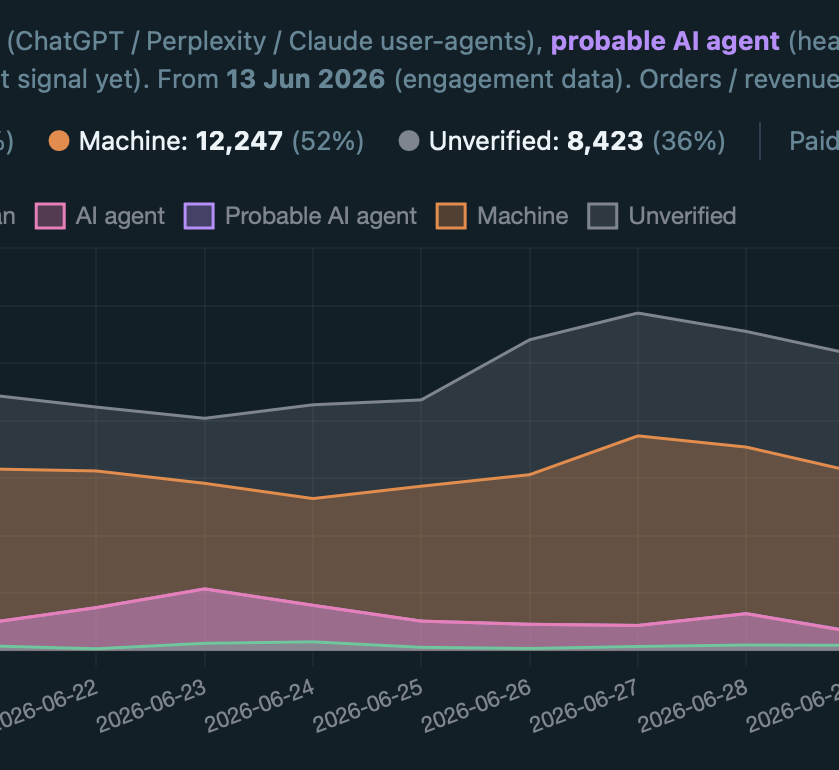
I once wrote about building my own privacy-friendly analytics tool. It had bot detection from the first version, yet it was not enough. Direct visits took a strangely high share of my traffic. When someone claims that 20% of their visits are bots and 80% are humans, I used to think the same. Today I would say the opposite ratio is closer to the truth. This is how I got there.
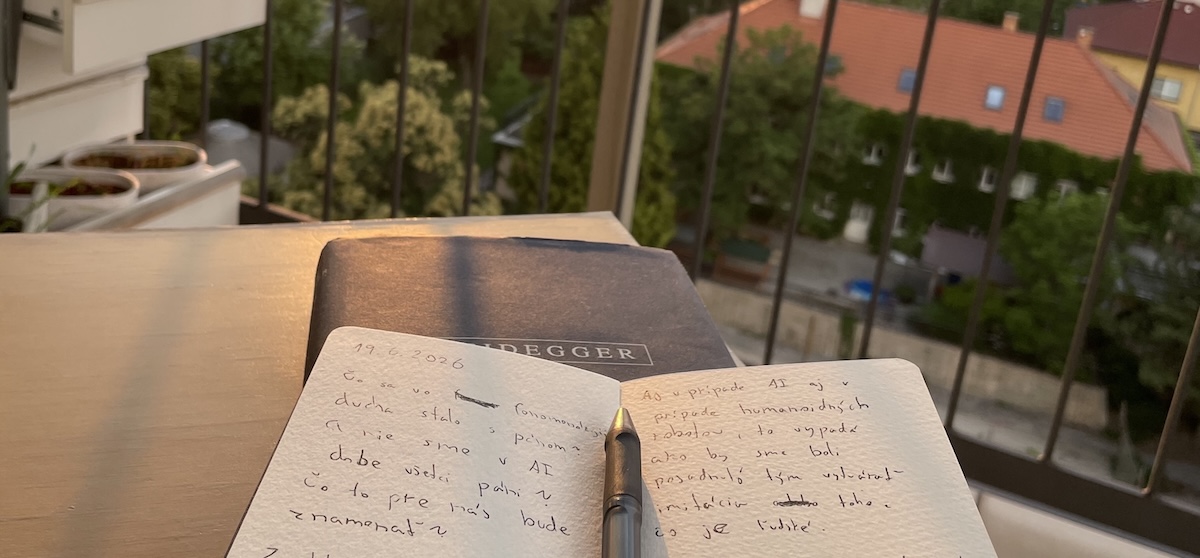
I have Heidegger and my notebook beside me. I am asking where all of this is heading, where artificial intelligence is taking us.
Seventy per cent. That is where the first AI output begins, even when you give it the full company context and the best examples from the past. We are talking about the kind of output that cannot be defined programmatically. It is more complex. Often it is creative work. On one repeated type of output I reached eighty per cent within a week. Every further percentage point is harder than the one before.
For a long time we treated the internet as the main road. The place where work and relationships happen. Yet most of what we see on it today is, or soon will be, AI-generated: text, images, profiles and comments. The internet is turning into an online game full of bots, where you cannot be sure that a human is on the other side of anything. So I ask: was the online world the main road, or only a temporary detour that part of us will return from, back offline?
A few days ago I interviewed a senior marketer. An experienced man, years of practice. I asked him about AI. He said he barely uses it. He had one bad experience with the output and decided he was too senior for it to add value when it is not perfect. I know the other side too: professionals who automate everything that can be automated.
Europe does not have the capacity to face a full-scale, mass drone war of the kind we see in Ukraine. Three dependencies weaken it: China supplies the physical material for defence systems, the United States supplies capabilities Europe does not have, and twenty-seven states cannot agree how fast, or who pays. Rearmament plans exist, but they are being carried out slowly.

Four days in Catalonia. No computer, no AI, almost no social media. I bought this notebook so that I could write down what I would think about, and what I would come across and learn on the trip.