


Article

I have already written about my approach to money and how I began investing. I have also discussed the importance of time in investing and why starting as soon as possible is crucial due to compound interest. Now, I will describe how to start investing and what to watch out for.
Investing in Individual Shares vs. Stock Market Index ETF
I will not focus on investments in individual shares. For most people, this is an inappropriate form of investment. The smartest minds on the planet, along with sophisticated algorithms, are dedicated to it. It is like playing football against Messi—nonsense for most of us. It makes more sense to benefit from the fact that the stock market grows in the long term. That is what I will focus on today: profiting from the stock market's long-term growth by investing in the world stock index.
What is a Stock Index?
A stock index is like a summary of how a group of companies is performing. Instead of checking each company one by one, the index gives you a quick look at how the whole group is doing. If it is going up, the group is doing well. If it is going down, they are having a tough time.
The Developed World Stock Index
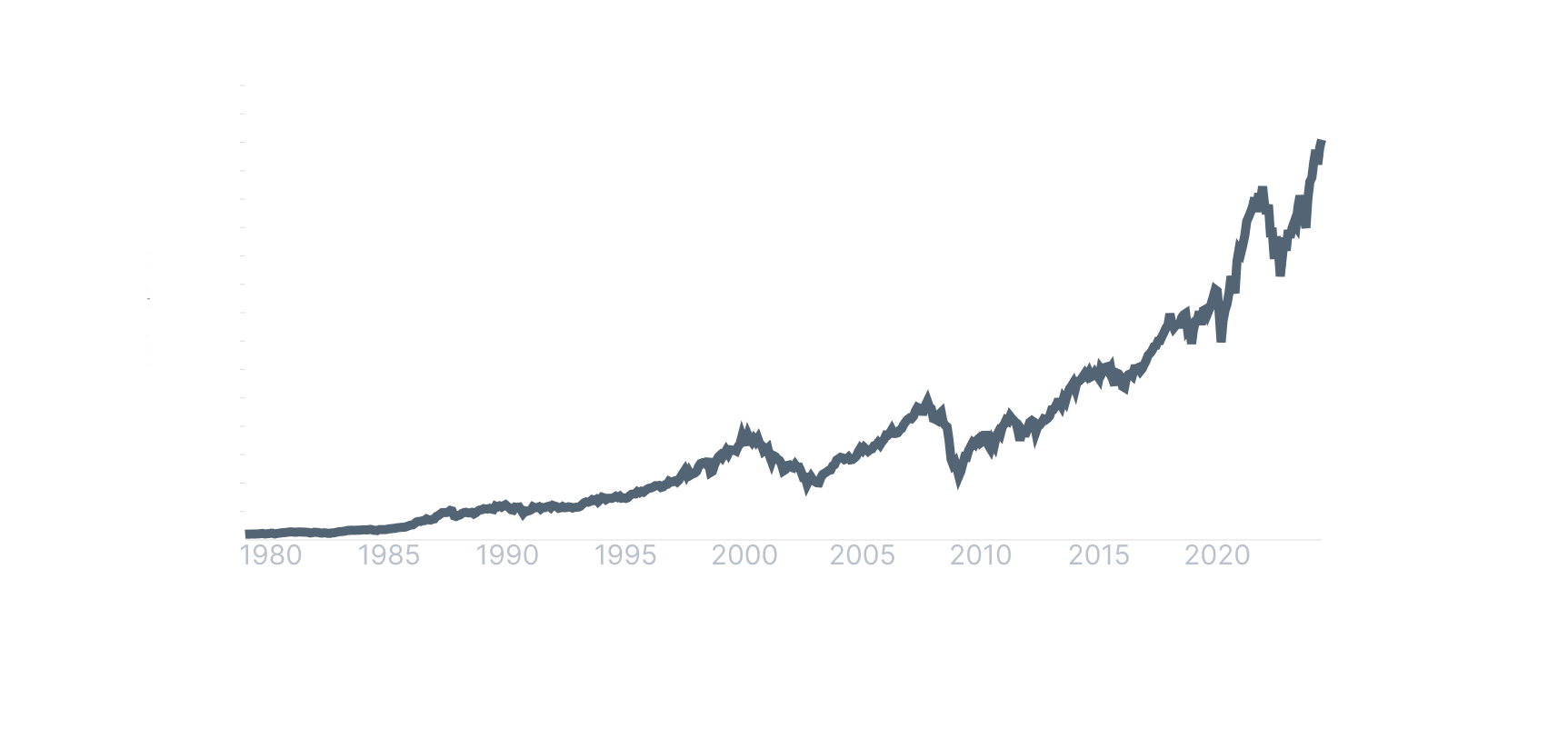
The developed world stock index (the MSCI World Index) has an average annual growth of more than 10%. I explained what an annual compound interest of 10% means in my previous post. I recommend reading it; understanding this concept motivated me to invest. Knowing that the entire stock market of the developed world grows at more than 10% per year, investing becomes an absolute no-brainer for anyone who thinks even a little about the future.
How to Invest in the World Stock Index
The answer is through ETFs (Exchange-Traded Funds).
What is an Index ETF?
Think of an ETF as a mix of different investments all packaged together. When you buy a share, you get a part of everything in that package. An index ETF is a type of ETF that follows a particular stock index. It is like buying a pre-made collection of all the stocks in that index, making investing easy and diversified.
Continue reading
Enter your email to unlock this article and join the newsletter. You can unsubscribe anytime.
Disclaimer
This article is intended for informational and educational purposes only. It does not constitute financial advice, a recommendation to buy or sell any securities, or a guarantee of future market performance. The views expressed are solely those of the author, who may also be an investor. Investing in financial markets involves risk, and each reader should make their own decisions independently and, if necessary, consult with a licensed professional.
Sources
Summary
Common questions on this article's topic
What is a stock index ETF?
What is the MSCI World Index?
What is TER and why does it matter?
How much money do I need to start investing in an ETF?
Accumulating or distributing ETF — which should I choose?
What mistakes do beginners make when choosing their first ETF?
If you have any thoughts, questions, or feedback, feel free to drop me a message at mail@richardgolian.com.
Related articles
I am building an AI system to predict the S&P 500. It runs on my own machine, uses free public data — yfinance, FRED, the Shiller dataset — and grades every forecast against reality. This series documents the build itself: the decisions, the methodology, the mistakes. What I will eventually share from the running system is a separate question, and an honest one.
If I take a certain risk, how much can I gain — and how much can I lose?
Interesting opportunities often appear where nothing seems to be happening.
More articles
Yesterday I could not tear myself away from the computer. When I lifted my head, it was half past eight in the evening. I had been sitting alone upstairs for about three hours.
Will AI take my job? A certified Google trainer told me in June 2024 that my profession would cease to exist. Twenty-two months later, my job title has not changed — but ninety percent of what I do during the day is different. I have delegated more of my thinking to AI agents than I thought possible. I am not afraid. This is why, and what it means for anyone asking the same question.
One hour. Fifty-five minutes. That is how long it took to build what a Czech software firm had quoted at over €50,000. I built it with Claude Code. Not a prototype. Not a proof of concept. A working tool — the one the company actually needed. By the evening of the same day, it was running on staging. This is not about Claude Code. It is about what Claude Code exposes.
I have conducted roughly one hundred and fifty practical interviews over the past four years. Fifty for data specialist roles. A hundred for advertising and performance marketing specialists. Almost every one of them involved sitting down with a candidate over a practical task — something close to a real problem we actually need to solve at the company. Not theory. Not trivia. Applied problem-solving. Over time, I started noticing a pattern.
Before you can teach AI to understand anything, you need to see what it is hiding from you.
The moment other people needed access to it, the problem changed completely. It was no longer about whether the agent could learn. It was about who gets to teach it.
I wanted to build an agent that doesn't just assist. One that acts.
This is what I learned about local vs cloud AI, and why I switched to Claude Code.
What happened — and how can it be reversed?