

Article
What Is Minimalism? Simplicity, Focus and Productivity

My name is Richard Golian. Amidst life's hustle and bustle, I have discovered that I require little. Time for personal passions and the joy of being with those who value my presence just as I value theirs.
Am I a minimalist? What does minimalism mean?
For me it is not a trend, and it is not a strict rule about how few things a person may own. It is a way of looking at life, and it can take different forms. A minimalist lifestyle, in my experience, is not about owning little because some guru tells me it will make my life better. For me it is about freeing time and energy for the activities and the people I care about.
My life's belongings might seem scant to some: a select number of books, clothing items in neutral colours, and essential tech gadgets. When it comes to meals, I like the consistency, almost every day the same breakfast and a few lunch rotations.
In short, my life is simple.
Simplicity
When navigating challenges, I veer towards uncomplicated solutions. Simplicity, in my experience, often yields the best results.
Continue reading for free
Enter your email to keep reading for free. This also subscribes you to my monthly newsletter. No spam, unsubscribe anytime.
Summary
Common questions on this article's topic
What is minimalism?
How do you start living minimally and become a minimalist?
Does single-tasking really produce better results than multitasking?
How does minimalism improve productivity?
Why is clear communication linked to productivity?
Is it better to have one clear goal or many tasks?
Can a simple lifestyle lead to better professional results?
How do you transition from multitasking to focused work?
If you have any thoughts, questions, or feedback, feel free to drop me a message at mail@richardgolian.com.
 LinkedIn


More articles
One of my family members described a firm that has its data in several different tools, and its employees still join it by hand, in spreadsheets. That is the ordinary state of firms. When somebody tells such people not to do it by hand and to use AI, they will not understand. Most firms do not even have the basic connectors between the tools they use. These firms need help with AI transformation.
The same task, two models. Fable 5 against Opus 4.8. On paper Fable is the better model, with a larger context and stronger specs. And still it lost. Opus handled the task with a single round of checking for 721,000 tokens, while Fable needed nine rounds and burnt through 2.78 million tokens. The difference was not in the model, but in how I set the task. And I know it, because I measured it.
A few weeks ago I installed a small local AI model on my laptop that watches a live camera feed. I turned the webcam on in the dark, and in near total darkness it recognised me and the objects in the room. That such things exist, I have known for a long time. What opened my eyes was the accessibility. I installed it in one prompt, free, and it runs entirely on my machine, sending data nowhere.
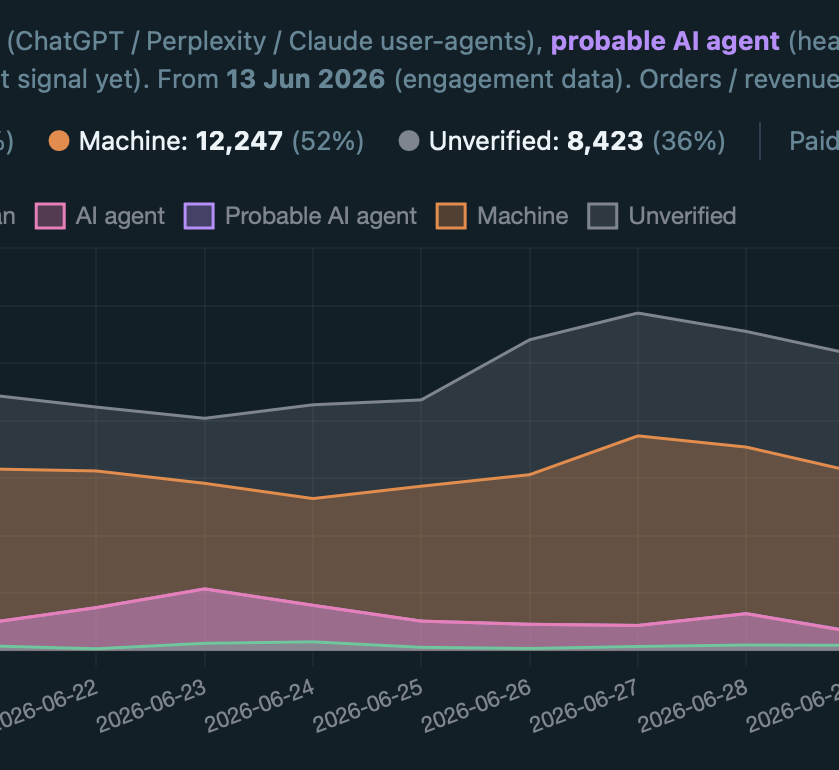
I once wrote about building my own privacy-friendly analytics tool. It had bot detection from the first version, yet it was not enough. Direct visits took a strangely high share of my traffic. When someone claims that 20% of their visits are bots and 80% are humans, I used to think the same. Today I would say the opposite ratio is closer to the truth. This is how I got there.
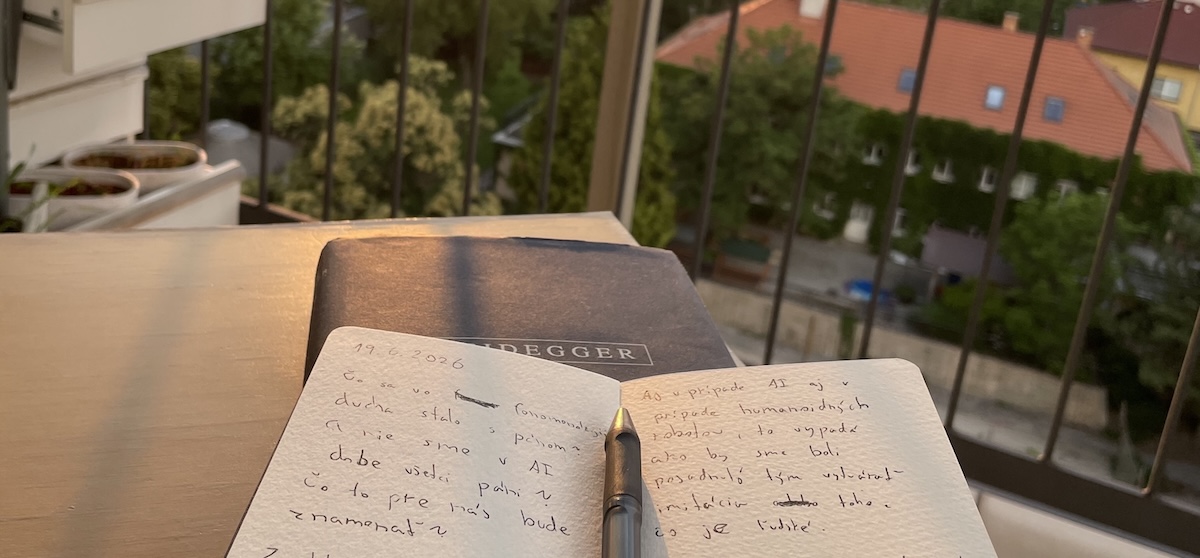
I have Heidegger and my notebook beside me. I am asking where all of this is heading, where artificial intelligence is taking us.
Seventy per cent. That is where the first AI output begins, even when you give it the full company context and the best examples from the past. We are talking about the kind of output that cannot be defined programmatically. It is more complex. Often it is creative work. On one repeated type of output I reached eighty per cent within a week. Every further percentage point is harder than the one before.
For a long time we treated the internet as the main road. The place where work and relationships happen. Yet most of what we see on it today is, or soon will be, AI-generated: text, images, profiles and comments. The internet is turning into an online game full of bots, where you cannot be sure that a human is on the other side of anything. So I ask: was the online world the main road, or only a temporary detour that part of us will return from, back offline?
A few days ago I interviewed a senior marketer. An experienced man, years of practice. I asked him about AI. He said he barely uses it. He had one bad experience with the output and decided he was too senior for it to add value when it is not perfect. I know the other side too: professionals who automate everything that can be automated.
Europe does not have the capacity to face a full-scale, mass drone war of the kind we see in Ukraine. Three dependencies weaken it: China supplies the physical material for defence systems, the United States supplies capabilities Europe does not have, and twenty-seven states cannot agree how fast, or who pays. Rearmament plans exist, but they are being carried out slowly.
AI produces the graphic, the newsletter and the product page faster than a person. What is left for the one who used to do it is the judgement, knowing whether the output is good. But most people have worse judgement than AI. And whoever cannot judge quality cannot delegate either. How do you tell whether yours is the judgement a company relies on, or the kind it can replace?
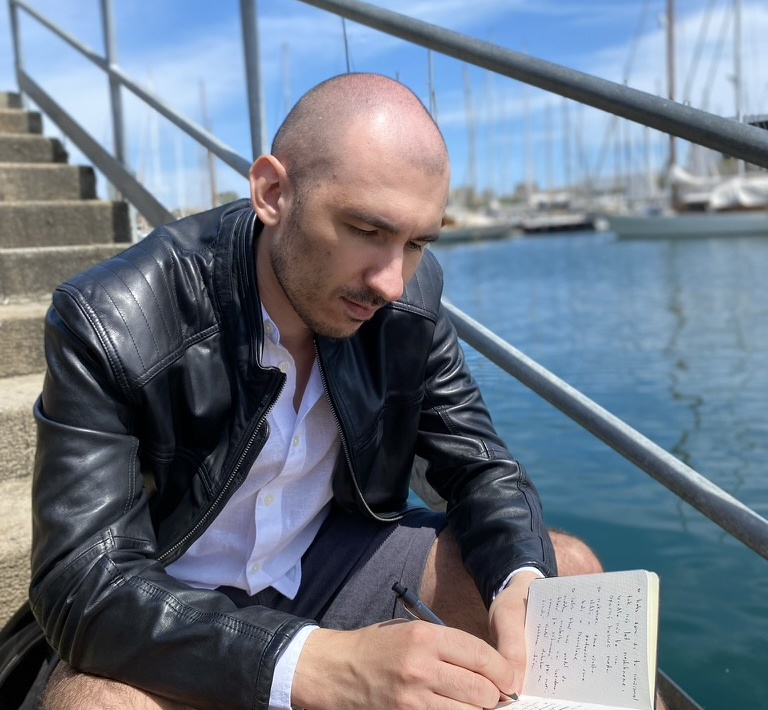
Four days in Catalonia. No computer, no AI, almost no social media. I bought this notebook so that I could write down what I would think about, and what I would come across and learn on the trip.