


Article
Stock Market Optimism and Media Manipulation

January 2025
Yesterday, I witnessed a glaring example of media misinformation while watching a Slovak TV channel. During the prime-time news, the report confidently claimed that the growth of the S&P 500 index was directly tied to the growth of corporate earnings. Accompanied by charts of recent stock price developments, this narrative was presented as fact, but it was nothing more than an overly optimistic distortion. It was yet another example of the excessive optimism I highlighted in December 2024.
The reality tells a very different story. Over the past two years, the earnings of American companies in the S&P 500 index have not kept pace with their share prices. Stock prices have risen dramatically faster, resulting in a historically high price-to-earnings (PE) ratio. This valuation metric, which is public and readily accessible, reflects heightened expectations for future earnings growth, expectations now at historically elevated levels.
The market is brimming with optimism, but is it truly justified?
Such a wide gap between share prices and underlying earnings often signals trouble ahead. Whether through price corrections or long-term stagnation, the current market dynamic suggests that this optimism may soon face a harsh reality.
As I wrote before, this is not a reason to panic, but it is a reason to pause, ask questions, and ensure decisions are based on facts rather than narratives.
Disclaimer
This article is intended for informational and educational purposes only. It does not constitute financial advice, a recommendation to buy or sell any securities, or a guarantee of future market performance. The views expressed are solely those of the author, who may also be an investor. Investing in financial markets involves risk, and each reader should make their own decisions independently and, if necessary, consult with a licensed professional.
Summary
Common questions on this article's topic
Can financial media present misleading narratives about the stock market?
What does a high price-to-earnings ratio actually tell us?
How do financial media amplify unjustified market optimism?
How can investors protect themselves from media-driven narratives?
Why do media outlets present overly optimistic financial narratives?
What was the actual state of the market in early January 2025?
If you have any thoughts, questions, or feedback, feel free to drop me a message at mail@richardgolian.com.
 LinkedIn


Related articles
Prague, 13 May 2026. On my way to work I started thinking about something that stayed with me for days. If most routine work on a computer disappears in the next ten years, and a large share of repetitive manual work disappears with it, what happens to the flow of money? Who pays whom for what? Which economic layers will exist, how large will they be, and what relationships will run between them? This is the six-layer map I sketched as an answer.
It is real, growing, and potentially devastating.
In April, in the first part of this series, I wrote about an AI prediction system I had started building on my own machine. At the time the software was a few hours old and the prediction record was empty. The record since then has shown one thing: the system does not yet understand the market it is being asked to forecast. It can pull macro context, book value, earnings. But it cannot put those together into something that helps it understand the price.
More articles
The same task, two models. Fable 5 against Opus 4.8. On paper Fable is the better model, with a larger context and stronger specs. And still it lost. Opus handled the task with a single round of checking for 721,000 tokens, while Fable needed nine rounds and burnt through 2.78 million tokens. The difference was not in the model, but in how I set the task. And I know it, because I measured it.
A few weeks ago I installed a small local AI model on my laptop that watches a live camera feed. I turned the webcam on in the dark, and in near total darkness it recognised me and the objects in the room. That such things exist, I have known for a long time. What opened my eyes was the accessibility. I installed it in one prompt, free, and it runs entirely on my machine, sending data nowhere.
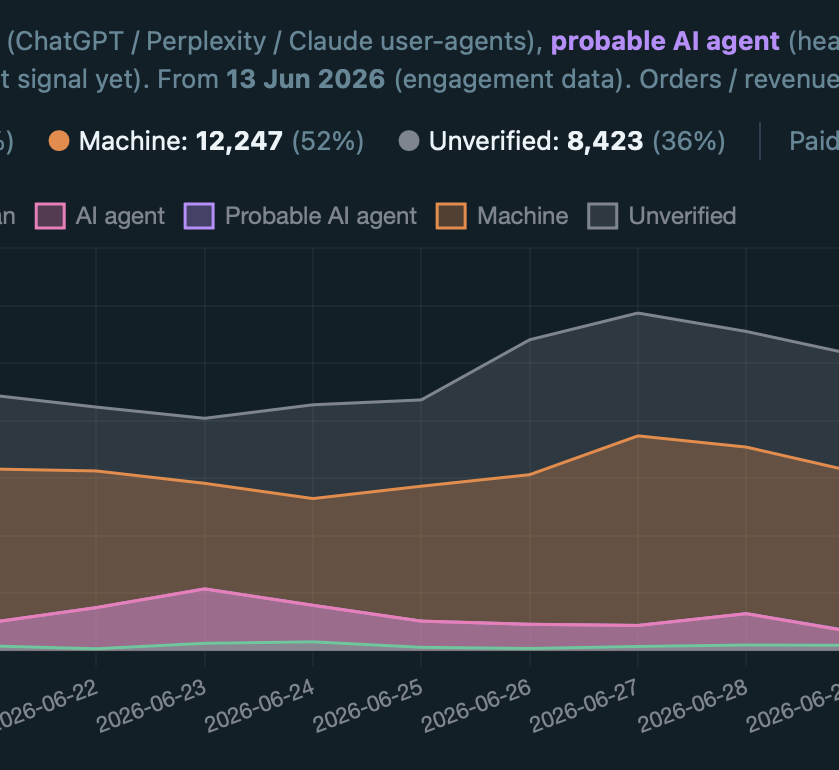
I once wrote about building my own privacy-friendly analytics tool. It had bot detection from the first version, yet it was not enough. Direct visits took a strangely high share of my traffic. When someone claims that 20% of their visits are bots and 80% are humans, I used to think the same. Today I would say the opposite ratio is closer to the truth. This is how I got there.

I have Heidegger and my notebook beside me. I am asking where all of this is heading, where artificial intelligence is taking us.
Seventy per cent. That is where the first AI output begins, even when you give it the full company context and the best examples from the past. We are talking about the kind of output that cannot be defined programmatically. It is more complex. Often it is creative work. On one repeated type of output I reached eighty per cent within a week. Every further percentage point is harder than the one before.
For a long time we treated the internet as the main road. The place where work and relationships happen. Yet most of what we see on it today is, or soon will be, AI-generated: text, images, profiles and comments. The internet is turning into an online game full of bots, where you cannot be sure that a human is on the other side of anything. So I ask: was the online world the main road, or only a temporary detour that part of us will return from, back offline?
A few days ago I interviewed a senior marketer. An experienced man, years of practice. I asked him about AI. He said he barely uses it. He had one bad experience with the output and decided he was too senior for it to add value when it is not perfect. I know the other side too: professionals who automate everything that can be automated.
Europe does not have the capacity to face a full-scale, mass drone war of the kind we see in Ukraine. Three dependencies weaken it: China supplies the physical material for defence systems, the United States supplies capabilities Europe does not have, and twenty-seven states cannot agree how fast, or who pays. Rearmament plans exist, but they are being carried out slowly.
AI produces the graphic, the newsletter and the product page faster than a person. What is left for the one who used to do it is the judgement, knowing whether the output is good. But most people have worse judgement than AI. And whoever cannot judge quality cannot delegate either. How do you tell whether yours is the judgement a company relies on, or the kind it can replace?

Four days in Catalonia. No computer, no AI, almost no social media. I bought this notebook so that I could write down what I would think about, and what I would come across and learn on the trip.