



Article
AI Agent Memory: Training an Agent That Learns Between Sessions

What is an AI agent? In my own practice, an AI agent is a program that does not just answer questions, it acts. It retrieves data on a schedule, analyses what it finds, proposes the next step, and checks its own output against a standard before sending anything. That is what separates an agent from a chatbot. The harder question, and the subject of this article, is AI agent memory: whether the agent can carry what it learned in one session into the next, or whether it starts again from zero every time.
The goal I set myself
I wanted to build an agent that does not just assist. One that acts.
The idea was straightforward: configure automations to retrieve data, let the agent analyse what it finds, have it propose next steps, send those proposals somewhere for review, and through that feedback loop, gradually improve. At a certain point, once its proposed steps consistently matched what I considered good decisions, it would stop waiting for approval and start executing on its own.
Not a chatbot. Not a co-pilot. An autonomous system that earns its authority through demonstrated accuracy.
That was the goal. I wrote about parts of it in my previous article on local AI models. This is the next chapter.
WHAT I BUILT, AND WHAT IT COULD NOT DO
The first version was simple by design. But the interesting part was not what it did. The interesting part was what it could not do.
The agent runs on a schedule. It retrieves data, analyses it, and sends a report to Slack. To make sure the output was consistent, I created a schema, an approved format the agent checks itself against before sending anything. If something does not match, it corrects itself. It loops until the output passes. If something prevents it from completing the process, such as a failed LLM call, it does not send a degraded output. It sends an alert to Slack instead.
I also added positive examples. Approved outputs from previous runs that the agent can reference when producing the next one.
This felt like a solid system. And for a while, I thought it was.
THE THING THAT KEPT BOTHERING ME
Every session starts from zero.
The schema is there. The examples are there. But the agent does not know what it struggled with yesterday. It does not know which rule it keeps violating. It does not know what it has already figured out.
And that changes everything.
The self-correction loop works within a single session. Between sessions, nothing accumulates. So the inconsistency I was seeing was not a configuration problem. It was not a prompting problem.
The problem was not technical. It was structural.
SELF-CORRECTION VS SELF-IMPROVEMENT
This is where I realised something important.
Self-correction means the agent catches its own errors before sending output. It happens inside one run, against a fixed schema. The session ends, and whatever the agent learned disappears.
Self-improvement means the agent builds something across runs. Each session leaves a trace that the next session can use. Errors become rules. Rules become context. Context shapes the next output before generation even starts.
The first is a quality filter. The second is something closer to learning.
And this distinction is not just about AI agents. It is the difference between systems that repeat and systems that evolve. Between people who fix mistakes and people who stop making the same ones. Most organisations have self-correction. Very few have genuine self-improvement. The mechanism looks similar from the outside. The architecture underneath is completely different.
What I had was a good quality filter. What I was missing was the accumulation layer underneath it.
HOW TO GIVE AN AI AGENT MEMORY
This is a fair question, and one I had to work through myself.
Claude Code has a file called CLAUDE.md. It loads automatically at the start of every session. When you tell the agent to remember something for future runs, it can write it there. And next time, it will be there. That is real persistence. It is not an illusion.
So when Claude Code confirms it will remember something, it is not lying.
The problem is what "there" actually means in practice.
Join the Library
Full access to my findings, personal stories, and what I learn from the people I meet.
Join the Library · €29.99 per year What should I study in the age of AI?… I Left My Job for Several Months to Read… How I Fell in Love With Her, at First… How do you stop depending on social media? Can… How to Start With AI in a Company: Automating… Fable 5 vs Opus: I Ran the Same Audit…Get the full article by email and feel free to reply if you want to discuss it further.
Summary
Common questions on this article's topic
What is an AI agent?
Can AI have memory?
Can AI agents learn over time?
What is the difference between AI self-correction and self-improvement?
What is CLAUDE.md and what are its limitations for AI agents?
Why does every AI agent session start from zero?
What is a structured memory layer for AI agents?
Can you run autonomous AI agents locally?
What does it take to build an AI agent that earns autonomy?
If you have any thoughts, questions, or feedback, feel free to drop me a message at mail@richardgolian.com.
 LinkedIn


Related articles
In April, in the first part of this series, I wrote about an AI prediction system I had started building on my own machine. At the time the software was a few hours old and the prediction record was empty. The record since then has shown one thing: the system does not yet understand the market it is being asked to forecast. It can pull macro context, book value, earnings. But it cannot put those together into something that helps it understand the price.
I am building an AI system to predict the S&P 500. It runs on my own machine, uses free public data (yfinance, FRED, the Shiller dataset), and grades every forecast against reality. This series documents the build itself: the decisions, the methodology, the mistakes. What I will eventually share from the running system is a separate question, and an honest one.
Yesterday I could not tear myself away from the computer. When I lifted my head, it was half past eight in the evening. I had been sitting alone upstairs for about three hours.
More articles
The development of artificial intelligence changes how we look at which paths in life make sense. Which studies and which profession to choose.
It was Thursday, 31 March 2022, when I handed over the last of my responsibilities to my colleagues, closed my laptop and went to the library. I left my job for several months and immersed myself in philosophy. And I am immensely grateful for it. Today I am, like most people, on a merry-go-round, and it is hard for me to stop and think about the fundamental questions of my own life.
It was September 2023. My life, my work, everything was completely different from now. It was simpler. I owned almost nothing. I needed to film an advert, I went up to a floor inside the company where the product I needed for that advert was, and there I noticed her for the first time. She laughs at me when I describe it like this, but at that moment the universe told me, that is her.
How and why I am gradually leaving social media and the big platforms. When I read that Meta is testing a new way to charge for organic posts that link outside its platform, it confirms how right I was to become steadily less dependent on the big platforms and on social media. It does not mean I have left them completely. It means that whether or not I stay in touch with my readers depends on them less and less, and today almost not at all.
One of my family members described a firm that has its data in several different tools, and its employees still join it by hand, in spreadsheets. That is the ordinary state of firms. When somebody tells such people not to do it by hand and to use AI, they will not understand. Most firms do not even have the basic connectors between the tools they use. These firms need help with AI transformation.
The same task, two models. Fable 5 against Opus 4.8. On paper Fable is the better model, with a larger context and stronger specs. And still it lost. Opus handled the task with a single round of checking for 721,000 tokens, while Fable needed nine rounds and burnt through 2.78 million tokens. The difference was not in the model, but in how I set the task. And I know it, because I measured it.
A few weeks ago I installed a small local AI model on my laptop that watches a live camera feed. I turned the webcam on in the dark, and in near total darkness it recognised me and the objects in the room. That such things exist, I have known for a long time. What opened my eyes was the accessibility. I installed it in one prompt, free, and it runs entirely on my machine, sending data nowhere.
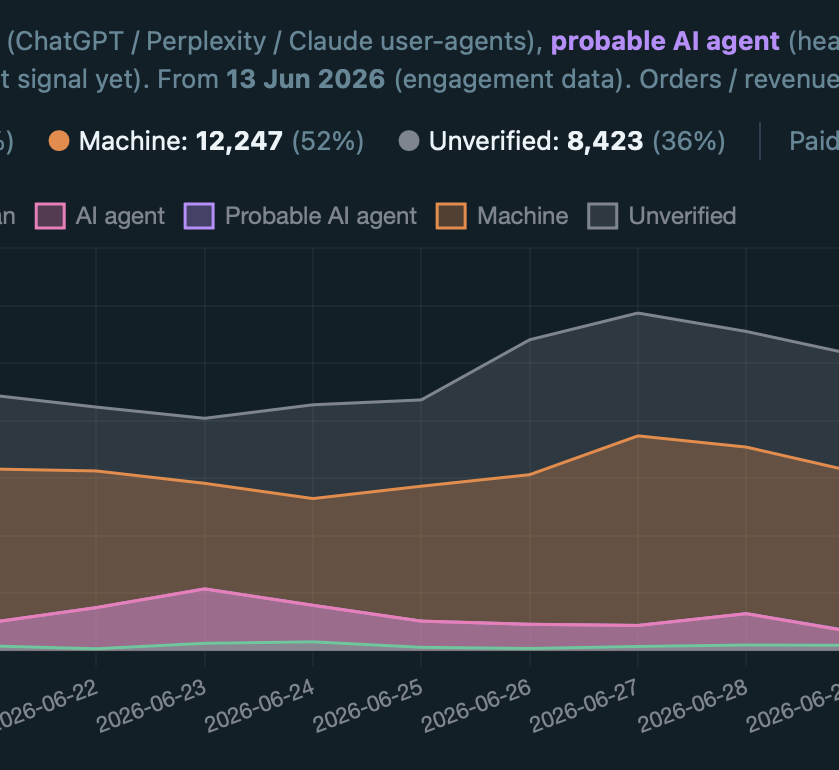
I once wrote about building my own privacy-friendly analytics tool. It had bot detection from the first version, yet it was not enough. Direct visits took a strangely high share of my traffic. When someone claims that 20% of their visits are bots and 80% are humans, I used to think the same. Today I would say the opposite ratio is closer to the truth. This is how I got there.

I have Heidegger and my notebook beside me. I am asking where all of this is heading, where artificial intelligence is taking us.
Seventy per cent. That is where the first AI output begins, even when you give it the full company context and the best examples from the past. We are talking about the kind of output that cannot be defined programmatically. It is more complex. Often it is creative work. On one repeated type of output I reached eighty per cent within a week. Every further percentage point is harder than the one before.

Four days in Catalonia. No computer, no AI, almost no social media. I bought this notebook so that I could write down what I would think about, and what I would come across and learn on the trip.