



Article
AI's Unexpected Role in Enhancing My Coding Skills

I Was Wrong
When I first started using ChatGPT for SQL queries, I was blown away by how it transformed hours-long tasks into mere minutes of processing. However, This staggering efficiency brought an unexpected quandary. Did I still need to improve my skills if AI could outperform me so dramatically? Initially, I saw little reason to compete against such precision. Yet, this was a fundamental misunderstanding on my part. As I integrated AI more deeply into my work, I discovered its value not just in handling tasks but in significantly enhancing my coding abilities by pushing the boundaries of what I thought possible.
Exploring the Depths of SQL with AI
ChatGPT became more than a tool; it became a mentor. As I tasked it with more complex queries, each solution it provided was not only a completed task but also a lesson in advanced SQL. This AI did not just do the work. It illuminated paths I had not even considered, turning complex data manipulation and optimisation techniques into understandable, approachable concepts.
Today, my ability to leverage advanced SQL functionalities is intricately tied to my deepened understanding of the code that AI generates. ChatGPT is instrumental in this process; it deconstructs each code line, explaining its rationale and strategy. This is not just about following steps; it is about grasping the underlying principles that make those steps effective.
Now, as I deal with more complex queries involving elaborate conditions and data filtering that require high computational effort, ChatGPT also proves invaluable from another point of view. It optimises code to ease server load and explains every step, helping me understand this area. This allows me to handle previously daunting complex tasks and equips me with the knowledge to instruct AI more effectively in the future.
Looking back on the path from doubt to reliance, I am amazed at how my perspective on AI has transformed. What began as a tool to expedite mundane tasks has blossomed into a crucial element of my professional development, pushing me to learn and adapt at an unprecedented pace.
Summary
Common questions on this article's topic
Can AI actually help you become a better programmer?
How does AI serve as a coding mentor?
Is it worth learning to code if AI can write code for you?
Can AI help with SQL query optimisation?
How has the perception of AI among developers changed?
What is the relationship between AI assistance and professional growth?
If you have any thoughts, questions, or feedback, feel free to drop me a message at mail@richardgolian.com.
 LinkedIn


Related articles
Employees have the best AI models available at work, the connectors are hooked up, and colleagues already use them. And they still do not. AI adoption fails even when the tools are already there. It is not about time or AI skills. It is the inertia of old thinking.
The same task, two models. Fable 5 against Opus 4.8. On paper Fable is the better model, with a larger context and stronger specs. And still it lost. Opus handled the task with a single round of checking for 721,000 tokens, while Fable needed nine rounds and burnt through 2.78 million tokens. The difference was not in the model, but in how I set the task. And I know it, because I measured it.
A few weeks ago I installed a small local AI model on my laptop that watches a live camera feed. I turned the webcam on in the dark, and in near total darkness it recognised me and the objects in the room. That such things exist, I have known for a long time. What opened my eyes was the accessibility. I installed it in one prompt, free, and it runs entirely on my machine, sending data nowhere.
More articles
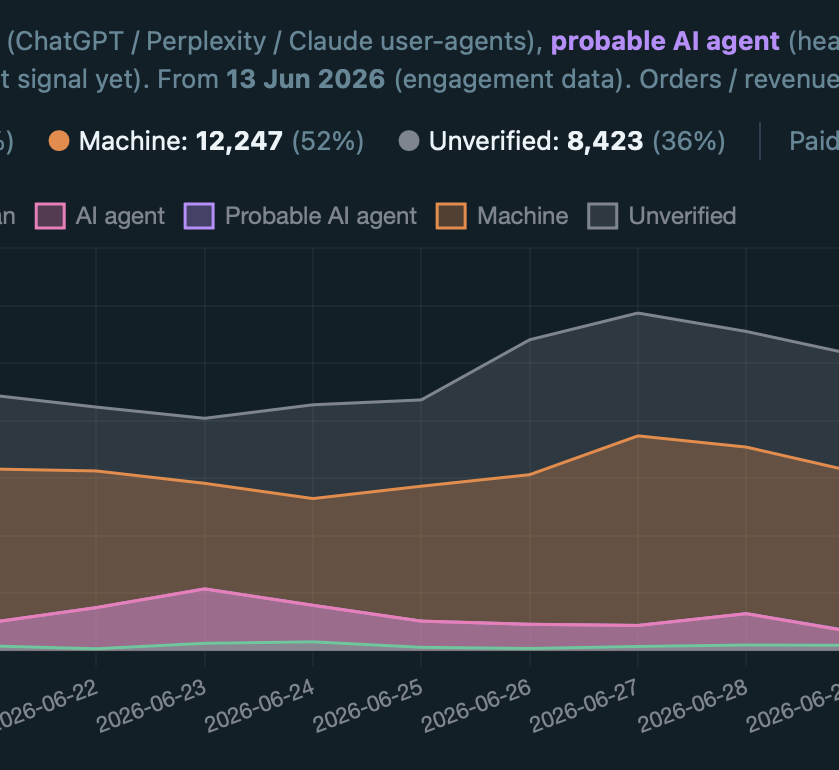
I once wrote about building my own privacy-friendly analytics tool. It had bot detection from the first version, yet it was not enough. Direct visits took a strangely high share of my traffic. When someone claims that 20% of their visits are bots and 80% are humans, I used to think the same. Today I would say the opposite ratio is closer to the truth. This is how I got there.
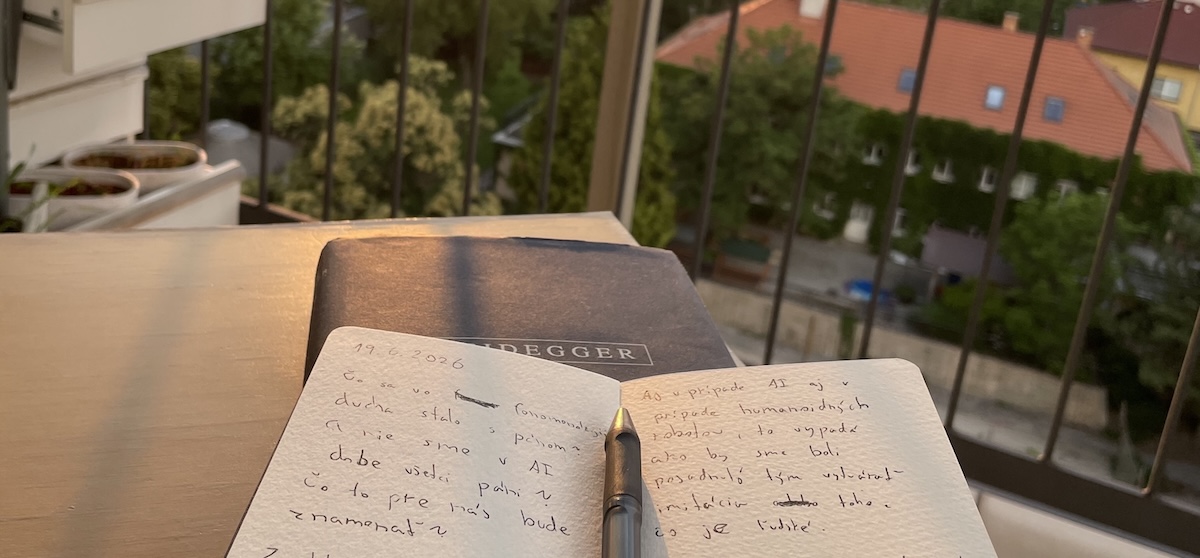
I have Heidegger and my notebook beside me. I am asking where all of this is heading, where artificial intelligence is taking us.
Seventy per cent. That is where the first AI output begins, even when you give it the full company context and the best examples from the past. We are talking about the kind of output that cannot be defined programmatically. It is more complex. Often it is creative work. On one repeated type of output I reached eighty per cent within a week. Every further percentage point is harder than the one before.
For a long time we treated the internet as the main road. The place where work and relationships happen. Yet most of what we see on it today is, or soon will be, AI-generated: text, images, profiles and comments. The internet is turning into an online game full of bots, where you cannot be sure that a human is on the other side of anything. So I ask: was the online world the main road, or only a temporary detour that part of us will return from, back offline?
A few days ago I interviewed a senior marketer. An experienced man, years of practice. I asked him about AI. He said he barely uses it. He had one bad experience with the output and decided he was too senior for it to add value when it is not perfect. I know the other side too: professionals who automate everything that can be automated.
Europe does not have the capacity to face a full-scale, mass drone war of the kind we see in Ukraine. Three dependencies weaken it: China supplies the physical material for defence systems, the United States supplies capabilities Europe does not have, and twenty-seven states cannot agree how fast, or who pays. Rearmament plans exist, but they are being carried out slowly.
AI produces the graphic, the newsletter and the product page faster than a person. What is left for the one who used to do it is the judgement, knowing whether the output is good. But most people have worse judgement than AI. And whoever cannot judge quality cannot delegate either. How do you tell whether yours is the judgement a company relies on, or the kind it can replace?
In April, in the first part of this series, I wrote about an AI prediction system I had started building on my own machine. At the time the software was a few hours old and the prediction record was empty. The record since then has shown one thing: the system does not yet understand the market it is being asked to forecast. It can pull macro context, book value, earnings. But it cannot put those together into something that helps it understand the price.

Four days in Catalonia. No computer, no AI, almost no social media. I bought this notebook so that I could write down what I would think about, and what I would come across and learn on the trip.