



Article
Robert Fico: Dividing Slovak Families Through Politics

Returning to Slovakia after spending time in Prague, I immediately felt the growing division that has gripped the nation. Under Robert Fico's leadership, policies such as questioning Slovakia's EU membership and shifting the country's foreign policy have polarized not only political discourse but also personal relationships. The result is a fractured society where even family gatherings often become battlegrounds for ideological clashes. While I strongly disagree with Fico's approach, this piece is not about his policies. Instead, it focuses on the societal rift that has widened under his leadership.
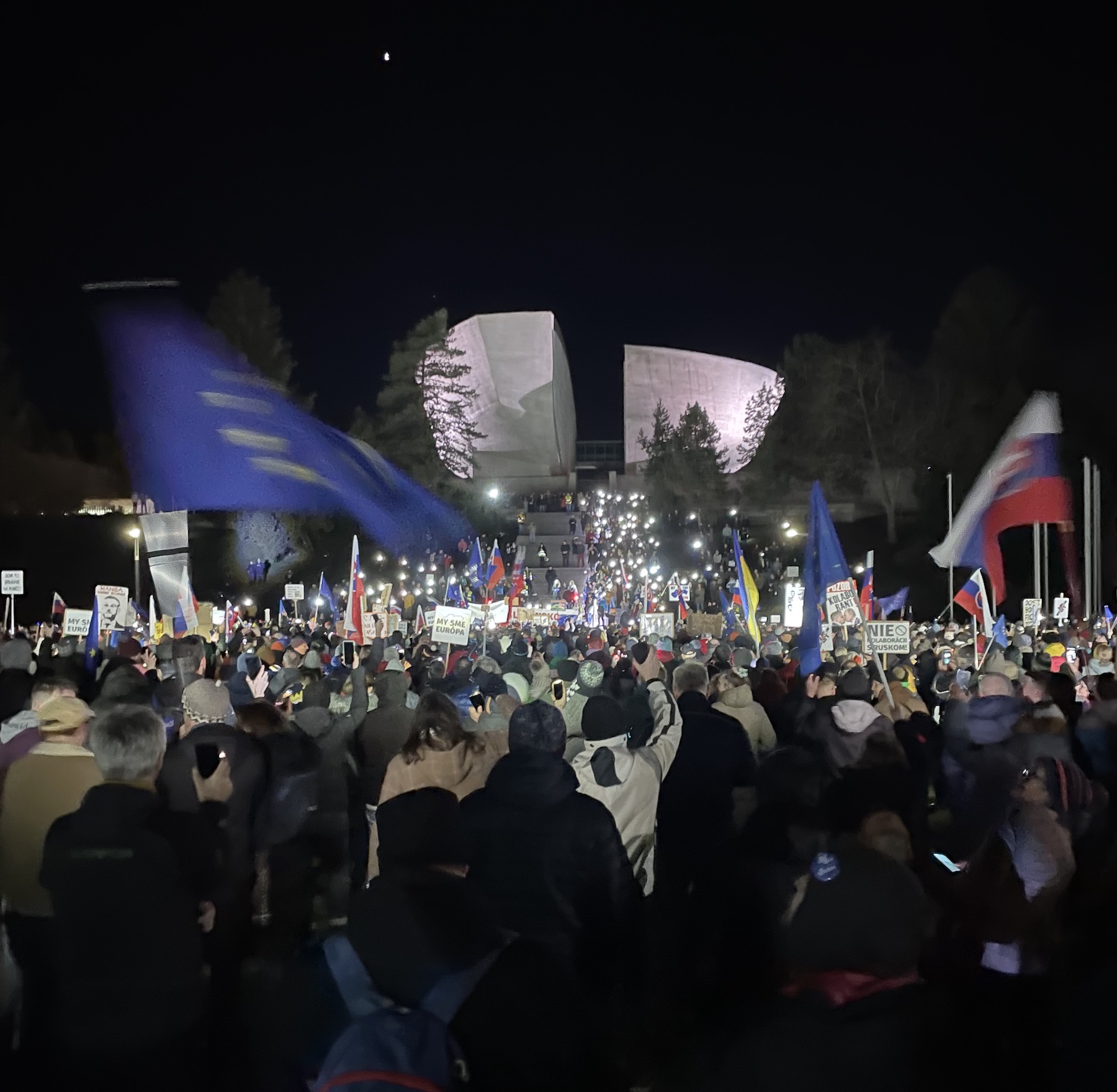
The fragmentation of information sources has created two parallel realities, where opposing groups interpret the political landscape through completely different lenses. This polarization has become a significant obstacle to constructive dialogue, leaving little room for mutual understanding.
I see this even within my own family. Increasingly, I question whether it is worth engaging in debates with relatives about their political views. Is the cost, whether it is heated arguments, sleepless nights, or strained relationships, worth it? For instance, is it worth upsetting my 85-year-old grandmother, who immediately ties any criticism of Robert Fico's government to her belief that younger generations are ungrateful? She often recalls how she had to make do with little in her youth, sewing her own clothes and managing everything on her own, and views today's generation as incapable of such self-reliance. Is it worth causing her sleepless nights or even raising her blood pressure over these discussions?
This raises a critical question: should we even discuss politics within our families? At first glance, this dilemma seems to present a painful choice between familial love and safeguarding the fundamental principles on which our republic and society are built.
But this dichotomy is misleading. Let me explain why.
Initially, I approached this question in precisely these terms. However, I have come to realise that the problem often lies not in what we communicate, but in how we communicate it. We often present our arguments in ways that resonate with those who already share our sources of information and worldview. But older generations, who often rely on entirely different sources, see the world differently. If we hope to foster even a basic level of mutual understanding, the foundation for any meaningful change in perspective, we must speak in a language that respects their lived experiences and builds bridges to our own perspective. Change rarely happens overnight; it requires patience and empathy.
This empathy must be paired with love and respect. By empathy, I mean recognising that few people act out of malice or with the intention of harming Slovakia. Most people, regardless of their political views, genuinely believe they are advocating for what is best for the country. Understanding this is crucial before entering any debate. We must seek to understand why the other side perceives what we see as harmful to be beneficial. Only then can we move forward to articulate why we believe their perspective is flawed.
While change is never immediate, each conversation lays a brick in the foundation of a shared, more accurate vision of what our country needs. I sincerely wish the best to anyone who takes on this challenge.
Summary
Common questions on this article's topic
Who is Robert Fico and why is he controversial?
Why is Slovak society so deeply divided?
How does political polarisation in Slovakia compare to other European countries?
What role does media fragmentation play in Slovak politics?
How has Slovakia's foreign policy shifted under Fico since 2023?
Is political division in Slovakia affecting everyday life?
If you have any thoughts, questions, or feedback, feel free to drop me a message at mail@richardgolian.com.
 LinkedIn


Related articles
Europe does not have the capacity to face a full-scale, mass drone war of the kind we see in Ukraine. Three dependencies weaken it: China supplies the physical material for defence systems, the United States supplies capabilities Europe does not have, and twenty-seven states cannot agree how fast, or who pays. Rearmament plans exist, but they are being carried out slowly.
It happens every day. It is happening right now.
Manipulation without the feeling of being manipulated is the most effective kind.
More articles
The development of artificial intelligence changes how we look at which paths in life make sense. Which studies and which profession to choose.
It was Thursday, 31 March 2022, when I handed over the last of my responsibilities to my colleagues, closed my laptop and went to the library. I left my job for several months and immersed myself in philosophy. And I am immensely grateful for it. Today I am, like most people, on a merry-go-round, and it is hard for me to stop and think about the fundamental questions of my own life.
It was September 2023. My life, my work, everything was completely different from now. It was simpler. I owned almost nothing. I needed to film an advert, I went up to a floor inside the company where the product I needed for that advert was, and there I noticed her for the first time. She laughs at me when I describe it like this, but at that moment the universe told me, that is her.
How and why I am gradually leaving social media and the big platforms. When I read that Meta is testing a new way to charge for organic posts that link outside its platform, it confirms how right I was to become steadily less dependent on the big platforms and on social media. It does not mean I have left them completely. It means that whether or not I stay in touch with my readers depends on them less and less, and today almost not at all.
One of my family members described a firm that has its data in several different tools, and its employees still join it by hand, in spreadsheets. That is the ordinary state of firms. When somebody tells such people not to do it by hand and to use AI, they will not understand. Most firms do not even have the basic connectors between the tools they use. These firms need help with AI transformation.
The same task, two models. Fable 5 against Opus 4.8. On paper Fable is the better model, with a larger context and stronger specs. And still it lost. Opus handled the task with a single round of checking for 721,000 tokens, while Fable needed nine rounds and burnt through 2.78 million tokens. The difference was not in the model, but in how I set the task. And I know it, because I measured it.
A few weeks ago I installed a small local AI model on my laptop that watches a live camera feed. I turned the webcam on in the dark, and in near total darkness it recognised me and the objects in the room. That such things exist, I have known for a long time. What opened my eyes was the accessibility. I installed it in one prompt, free, and it runs entirely on my machine, sending data nowhere.
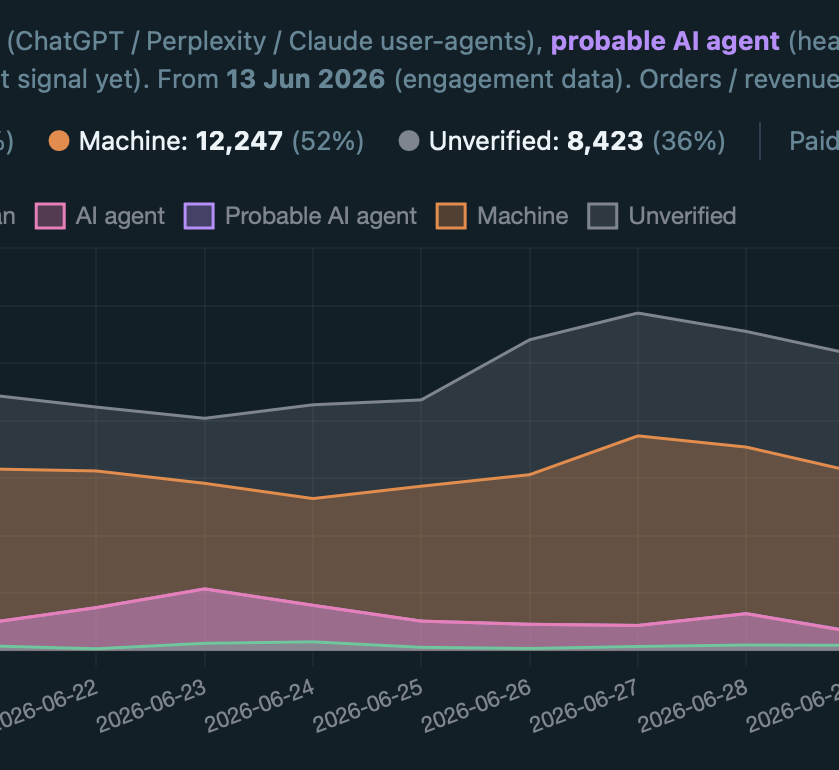
I once wrote about building my own privacy-friendly analytics tool. It had bot detection from the first version, yet it was not enough. Direct visits took a strangely high share of my traffic. When someone claims that 20% of their visits are bots and 80% are humans, I used to think the same. Today I would say the opposite ratio is closer to the truth. This is how I got there.
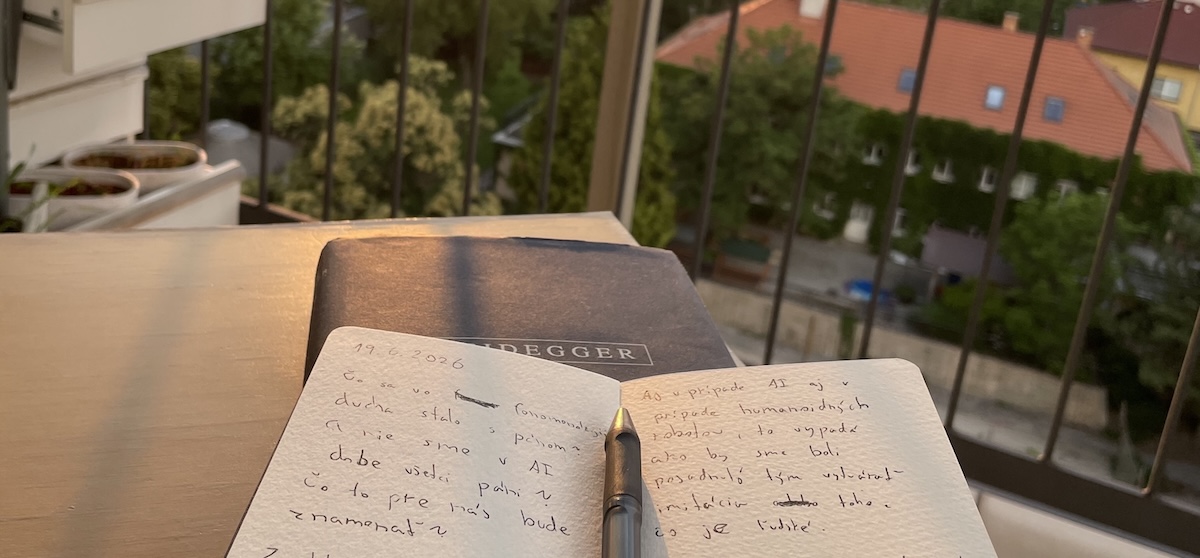
I have Heidegger and my notebook beside me. I am asking where all of this is heading, where artificial intelligence is taking us.
Seventy per cent. That is where the first AI output begins, even when you give it the full company context and the best examples from the past. We are talking about the kind of output that cannot be defined programmatically. It is more complex. Often it is creative work. On one repeated type of output I reached eighty per cent within a week. Every further percentage point is harder than the one before.

Four days in Catalonia. No computer, no AI, almost no social media. I bought this notebook so that I could write down what I would think about, and what I would come across and learn on the trip.