


Article
The Meaning of Life in the Age of Machines, Algorithms, and Artificial Intelligence

In my previous post, I reflected on what we need for a good life in an era increasingly shaped by artificial intelligence and automation. I concluded that it is meaning, today, tomorrow, and ten years from now. We need our lives and the world around us to have some sense of purpose, or at least for us to be on the path to finding it. When this sense of meaning disappears, it leaves behind an emptiness that most people find difficult to bear.
We typically find meaning in work, relationships, tasks, and hobbies. But what happens when most of these opportunities vanish? When machines and algorithms take over the majority of meaningful activities? When they perform most tasks better than we do? To what will we dedicate our time when the things that once gave our lives purpose become unnecessary? This emptiness arises not because we lack material things but because we lose what truly matters to us. It is one reason I value minimalism, keeping what matters and letting the rest go.
This feeling of emptiness is often referred to as anxiety.
The Phenomenon of Anxiety
I first became deeply interested in the concept of anxiety when I read Being and Time by Martin Heidegger during my university studies. It was challenging reading. In seminars, we dissected the text sentence by sentence. I had never encountered anything like it before, but the ideas this book offers are well worth the effort.
Heidegger describes anxiety as fundamental to existence, something that reveals the true nature of our being. Anxiety differs from ordinary fear. Fear always has a specific object. We fear illness, loss, or failure. Anxiety, however, has no specific object. In a state of anxiety, the world as a whole appears meaningless. Activities and relationships that we usually take for granted seem to lose their significance. This is not fear of something in the world; rather, it is a revelation of the fact that our being is our own responsibility, with no predetermined purpose.
Heidegger explains that anxiety confronts us with the state of Geworfenheit (thrownness), the realisation that we have been thrown into the world without our consent, without a clear guide on how to live within it. This recognition forces us to confront our freedom and responsibility, reminding us that no external framework provides the meaning we seek.
A key aspect of Heidegger’s conception of anxiety is that it grants us access to authentic being. When we recognise that our time is finite, we gain the opportunity to live on our own terms, rather than according to societal expectations. Anxiety, therefore, is not merely an uncomfortable state but a crucial moment of clarity in which we can reclaim the direction of our lives.
In the digital age, where algorithms and machines manage all practical matters, a unique challenge emerges. When everyday obligations that once distracted us disappear, we are left with only ourselves and one pressing question: What now?
In my view, we will stand at a crossroads. One path is to seek out new, meaningful activities. The other is to embrace anxiety and the questions and challenges it brings. Perhaps it is this second path that will ultimately lead us to a good and truly authentic life.
Ignoring these paths takes us somewhere too, just not where we would want to go. The question is how many people will follow other directions. I can imagine a future, a world where living a good life will not be that easy.
Join the Library
Full access to my findings, personal stories, and what I learn from the people I meet.
Join the Library · €29.99 per year How do you stop depending on social media? Can… How to Start With AI in a Company: Automating… Fable 5 vs Opus: I Ran the Same Audit… I Ran Object Detection on My Laptop, and Saw… Bot or Human? What My… Dependent on AI: Are We…Get the full article by email and feel free to reply if you want to discuss it further.
Sources
Summary
Common questions on this article's topic
What is existential anxiety according to Heidegger?
What is the difference between anxiety and fear in philosophy?
What is Geworfenheit (thrownness)?
How could AI and automation cause a crisis of meaning?
Can existential anxiety be a positive experience?
How can we find meaning in the age of artificial intelligence?
If you have any thoughts, questions, or feedback, feel free to drop me a message at mail@richardgolian.com.
 LinkedIn


Related articles
A few weeks ago I installed a small local AI model on my laptop that watches a live camera feed. I turned the webcam on in the dark, and in near total darkness it recognised me and the objects in the room. That such things exist, I have known for a long time. What opened my eyes was the accessibility. I installed it in one prompt, free, and it runs entirely on my machine, sending data nowhere.
I have conducted roughly one hundred and fifty practical interviews over the past four years. Fifty for data specialist roles. A hundred for advertising and performance marketing specialists. Almost every one of them involved sitting down with a candidate over a practical task, something close to a real problem we actually need to solve at the company. Not theory. Not trivia. Applied problem-solving. Over time, I started noticing a pattern.
Before you can teach AI to understand anything, you need to see what it is hiding from you.
More articles
How and why I am gradually leaving social media and the big platforms. When I read that Meta is testing a new way to charge for organic posts that link outside its platform, it confirms how right I was to become steadily less dependent on the big platforms and on social media. It does not mean I have left them completely. It means that whether or not I stay in touch with my readers depends on them less and less, and today almost not at all.
One of my family members described a firm that has its data in several different tools, and its employees still join it by hand, in spreadsheets. That is the ordinary state of firms. When somebody tells such people not to do it by hand and to use AI, they will not understand. Most firms do not even have the basic connectors between the tools they use. These firms need help with AI transformation.
The same task, two models. Fable 5 against Opus 4.8. On paper Fable is the better model, with a larger context and stronger specs. And still it lost. Opus handled the task with a single round of checking for 721,000 tokens, while Fable needed nine rounds and burnt through 2.78 million tokens. The difference was not in the model, but in how I set the task. And I know it, because I measured it.
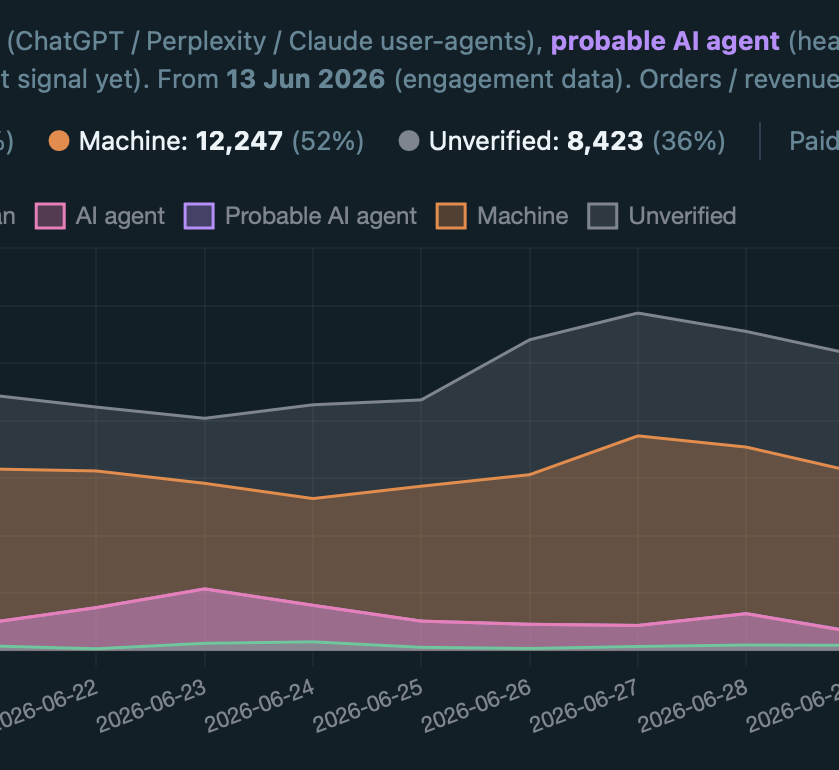
I once wrote about building my own privacy-friendly analytics tool. It had bot detection from the first version, yet it was not enough. Direct visits took a strangely high share of my traffic. When someone claims that 20% of their visits are bots and 80% are humans, I used to think the same. Today I would say the opposite ratio is closer to the truth. This is how I got there.
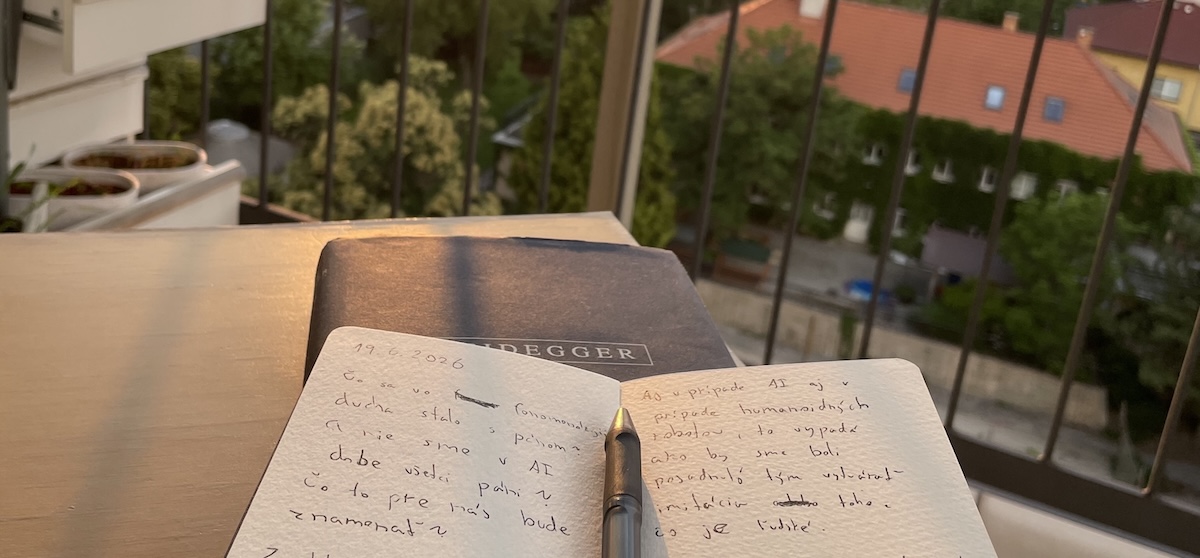
I have Heidegger and my notebook beside me. I am asking where all of this is heading, where artificial intelligence is taking us.
Seventy per cent. That is where the first AI output begins, even when you give it the full company context and the best examples from the past. We are talking about the kind of output that cannot be defined programmatically. It is more complex. Often it is creative work. On one repeated type of output I reached eighty per cent within a week. Every further percentage point is harder than the one before.
For a long time we treated the internet as the main road. The place where work and relationships happen. Yet most of what we see on it today is, or soon will be, AI-generated: text, images, profiles and comments. The internet is turning into an online game full of bots, where you cannot be sure that a human is on the other side of anything. So I ask: was the online world the main road, or only a temporary detour that part of us will return from, back offline?
A few days ago I interviewed a senior marketer. An experienced man, years of practice. I asked him about AI. He said he barely uses it. He had one bad experience with the output and decided he was too senior for it to add value when it is not perfect. I know the other side too: professionals who automate everything that can be automated.
Europe does not have the capacity to face a full-scale, mass drone war of the kind we see in Ukraine. Three dependencies weaken it: China supplies the physical material for defence systems, the United States supplies capabilities Europe does not have, and twenty-seven states cannot agree how fast, or who pays. Rearmament plans exist, but they are being carried out slowly.
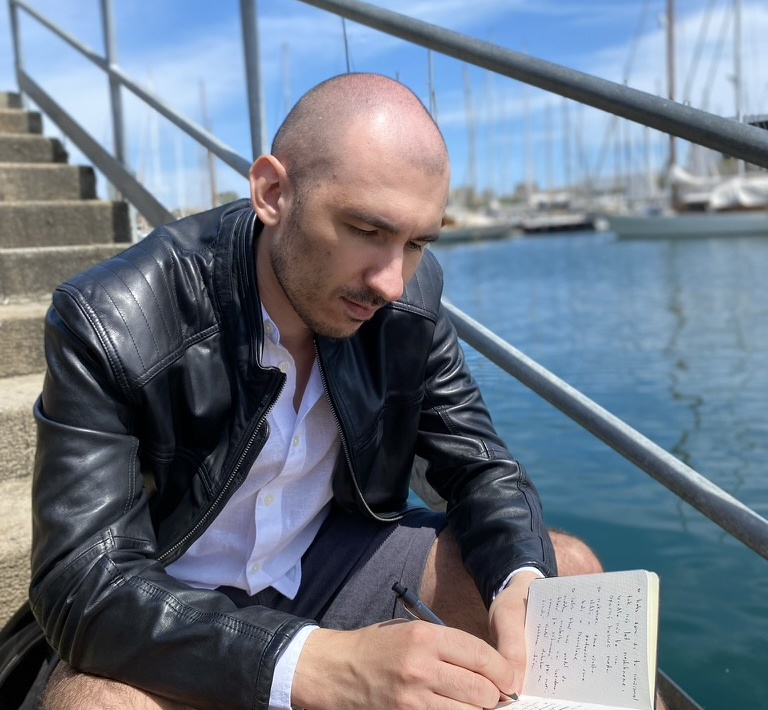
Four days in Catalonia. No computer, no AI, almost no social media. I bought this notebook so that I could write down what I would think about, and what I would come across and learn on the trip.